Table of Contents
Updated: July 2026
Let’s be real—when most people hear “Utah,” they instantly picture red rock country, sweeping desert vistas, and landscapes so stunning they barely look real. Arches National Park doesn’t just meet that expectation—it blows it out of the water. With more than 2,000 natural sandstone arches within its 76,518 acres, this park is nature showing off in the best possible way.
We’ve logged plenty of miles exploring this desert gem, so trust us when we say: one day here never feels like enough—but it’s still infinitely better than skipping it altogether. Located just five miles north of Moab, Utah, Arches is a super convenient stop on any Southwest road trip. And whether you’re an avid hiker or more of a scenic-drive-and-take-it-all-in type, this park delivers something for everyone.
This blog is intentionally free of pop-ups and intrusive ads to keep your reading experience simple and enjoyable. Instead, I use affiliate links for products I personally recommend. If you make a purchase through one of these links, I may earn a small commission at no additional cost to you. As an Amazon Associate, qualifying purchases made within 24 hours of clicking a link may earn a commission. If you find this site helpful, using one of my links is an easy way to support my work while keeping the blog ad-free. Thank you for your support! Read the full disclosure policy here.
Arches National Park is one of Utah’s Mighty 5 parks and pairs perfectly with Zion, Bryce Canyon, Capitol Reef, and Canyonlands National Parks as part of a Southwest Grand Circle road trip.
Getting to Arches National Park
Located just 5 miles north of Moab, Utah, Arches National Park is one of the easiest parks to access in Utah’s Mighty 5. The park entrance is a short drive from town, making Moab the ideal base for exploring Arches, Canyonlands, and nearby attractions.
Most visitors arrive by car:
- Moab, Utah: about 10–15 minutes
- Canyonlands Island in the Sky: about 45 minutes
- Salt Lake City: about 4 hours
- Las Vegas: about 6.5 hours
History of Arches National Park
Long before anyone drew boundaries around this land, people already knew this desert inside out. The Ancestral Puebloan and Ute peoples made this region home, leaving behind rock art, stone tools, and other evidence of their connection to this landscape.
Then came the homesteaders. In the late 1800s, settlers tried their hand at ranching in this rugged desert environment. John Wesley Wolfe was one of them, and his historic cabin still stands near the Delicate Arch trail—a quiet reminder that this land was challenging to live on, even if it is breathtaking to explore.
In 1929, President Herbert Hoover designated the area as Arches National Monument. It became Arches National Park in 1971, protecting one of the most unique landscapes in the country for future generations.
But the rock itself has been at work far longer. Over millions of years, wind and water slowly carved away layers of sandstone. Grain by grain, they shaped the fins, windows, and arches visitors hike to see today.

Know Before You Go: Arches National Park
- Hours: Arches National Park is open 24 hours a day, 365 days a year. The Visitor Center has more limited hours, typically from 7:30 AM to 4:30 PM, though hours may change seasonally. Before your visit, check the official Arches National Park website for current conditions, alerts, and seasonal updates.
- Entrance fees: $30 per vehicle (7-day pass), $15 for pedestrians or cyclists, or $80 for an annual America the Beautiful pass that gets you into every national park for a year.
- Timed entry: From April through October, visitors need a timed-entry reservation through Recreation.gov to enter the park between 6 AM and 5 PM. Outside those hours, entry is available without a reservation.
- Pets: Pets are allowed in Arches National Park but must remain leashed at all times. They are not permitted on hiking trails or in the backcountry, so plan on bringing them along for the scenic drive rather than the trails.
- Best time to visit: Spring and fall bring mild temperatures and thinner crowds. Summer regularly tops 100°F, so plan accordingly. Winter is quiet and surprisingly gorgeous for photography.
- Pack for the desert: Bring sturdy shoes, 2–3 liters of water per person, sun protection, snacks, and a paper map as a backup. Elevations in the park range from roughly 5,000 to 7,000 feet, so the desert sun can feel intense even during cooler months.
Be Prepared: Essential Gear Tips for Your One-Day Arches National Park Adventure
A day exploring Arches National Park means spending hours in an exposed desert environment, so coming prepared makes a huge difference. Bring plenty of water (2–3 liters per person), sunscreen, sunglasses, and a wide-brimmed hat—the Utah sun is intense, even during cooler months.
Comfortable hiking shoes with good traction are essential for navigating slickrock trails and uneven terrain. A lightweight daypack is perfect for carrying water, snacks, a small first-aid kit, and extra layers.
Other items we recommend bringing:
- Trail map or offline GPS access
- High-energy snacks
- Camera or smartphone for photos
- Lip balm with SPF
- Lightweight layers for changing temperatures
- Rain jacket for unexpected weather changes
A few extras can make your day easier, especially if you plan longer hikes:
- Headlamp for early starts or late finishes
- Trekking poles for added stability
- Small packable towel or bandana for cooling down
Always check the forecast before heading out and remember that desert conditions can change quickly.

Our One-Day Arches National Park Itinerary
If you only have one day in Arches National Park, you’ll want to make the most of your time. The park is easy to explore by scenic drive, but the best stops require getting out of the car and walking a few trails and viewpoints.
Courthouse Towers Viewpoint
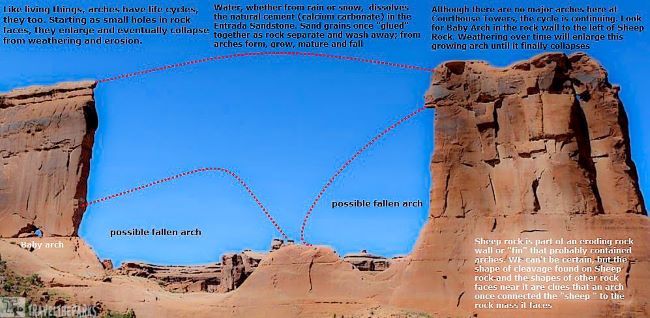
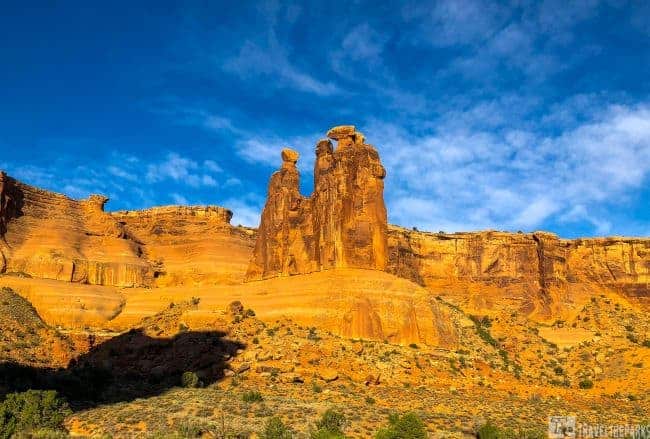
Your first stop in Arches National Park is a great introduction to the landscape ahead. From the viewpoint, you can see several impressive formations at once, including Three Gossips, Sheep Rock, The Organ, and the Tower of Babel, which rises nearly 300 feet above the desert floor.
These towering sandstone formations are the result of millions of years of erosion slowly shaping the landscape. It is a quick stop, but it gives you a preview of the incredible rock formations you’ll be seeing throughout the rest of the day.
Balanced Rock
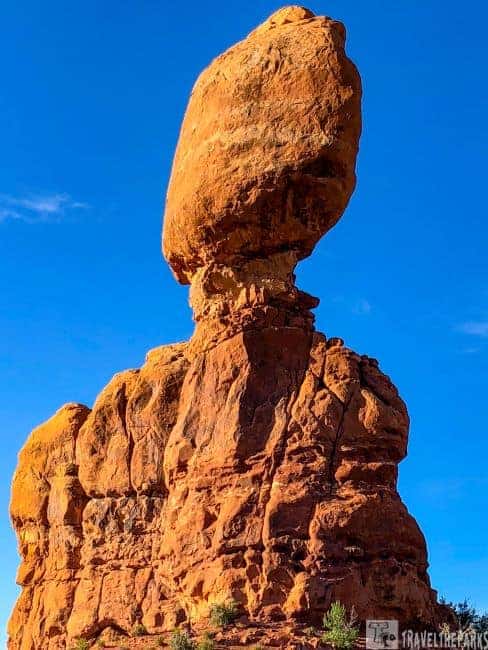
Here’s the thing about Balanced Rock—it almost feels like it shouldn’t exist. This massive 128-foot sandstone formation sits on a pedestal of softer rock that is slowly weathering away beneath it. Logic says this 3,500-ton boulder should have toppled long ago, but somehow, it continues to stand.
We spent about 20 minutes walking the loop trail around Balanced Rock, stopping to take photos from every angle. There is something fascinating about seeing a formation this massive seemingly defy gravity. It also makes you wonder how much longer it will remain. Another nearby formation known as “Chip Off the Old Block” collapsed in 1976, reminding visitors that these landscapes are constantly changing.
If you’re lucky, you may also spot wildlife nearby. We saw a couple of jackrabbits darting through the sagebrush early in the morning, which was an unexpected highlight of the stop.
Balanced Rock isn’t an arch, but it is one of Arches National Park’s most recognizable and photographed formations. The short loop trail makes it easy to experience this geological wonder from every angle.
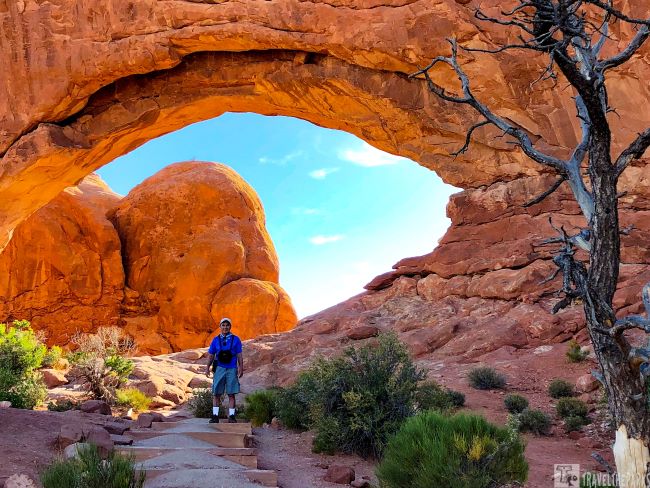
The Windows Section (and Double Arch)
his area is a treasure trove of arches and one of the most accessible parts of Arches National Park. The trails here are relatively short and easy, making this a great stop for families, photographers, or anyone who wants incredible views without a long hike.
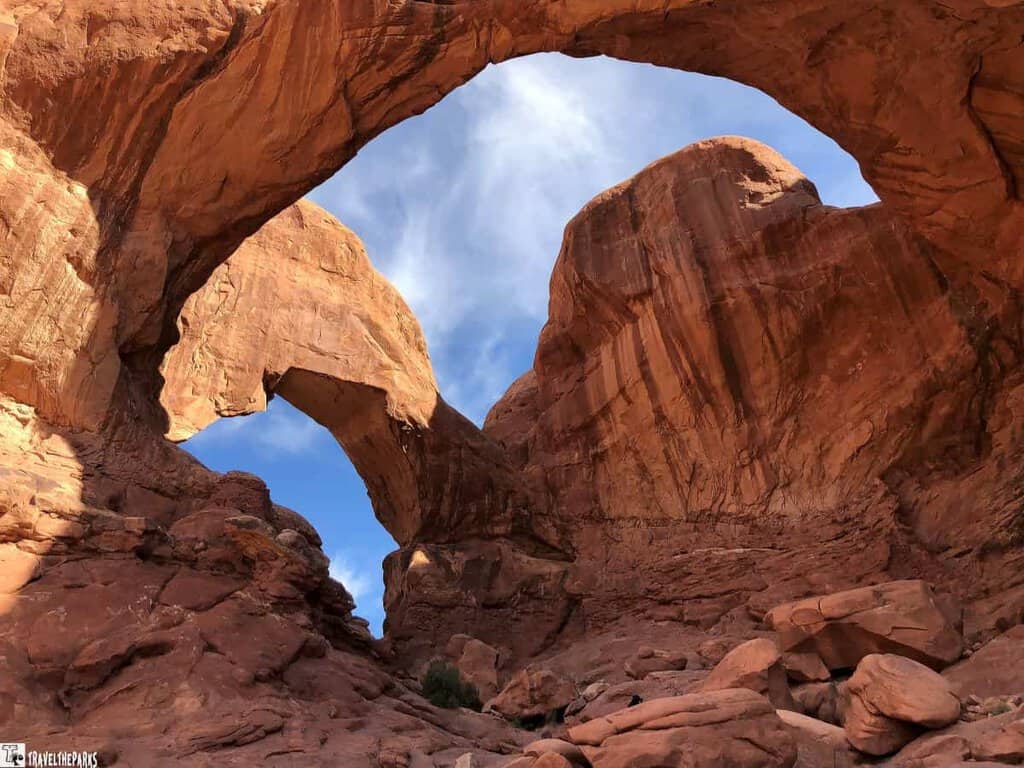
North Window, South Window, Turret Arch, and Double Arch are all located within a short walk of each other. We loved Double Arch the most (don’t tell the others). The two massive arches share a common foundation, creating a surreal, cathedral-like space that feels completely different from the rest of the park.
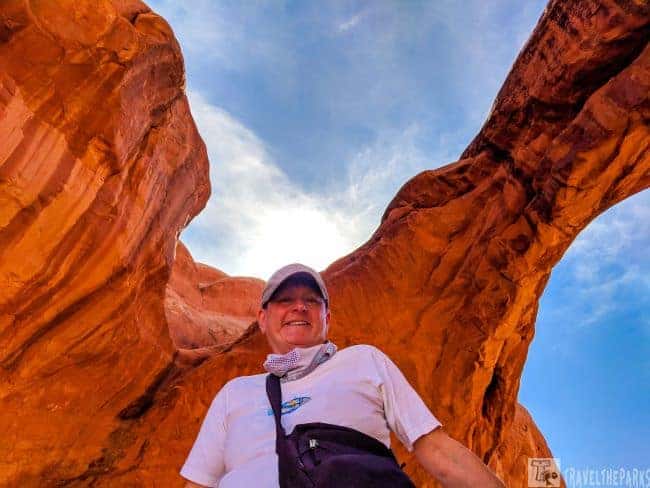
Double Arch is especially worth visiting early in the day when crowds are lighter and the softer morning light makes photography even better. The trail does involve some scrambling over slickrock near the base, so wear sturdy shoes. We saw a few people attempting it in flip-flops, and their expressions said everything.
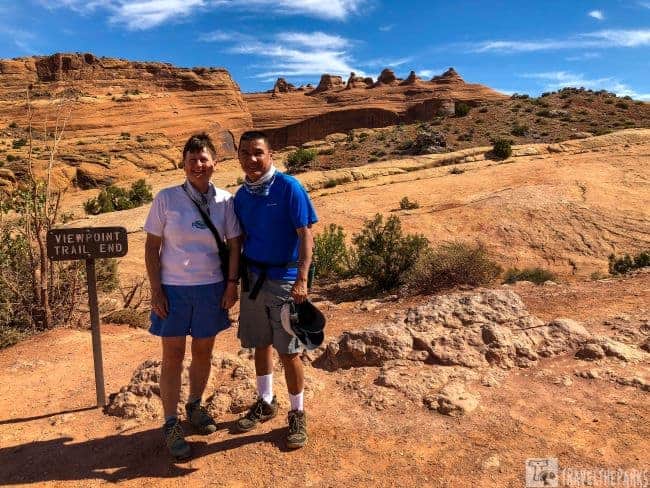
Upper Delicate Arch Viewpoint
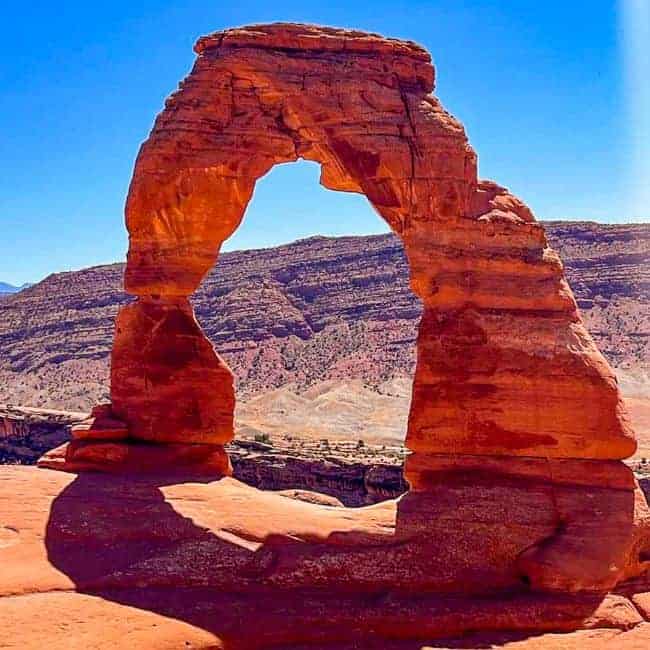
Delicate Arch is the superstar of Arches National Park—the one you see on Utah license plates, postcards, and just about every travel brochure featuring the state. It is the image most people picture when they think of this park.
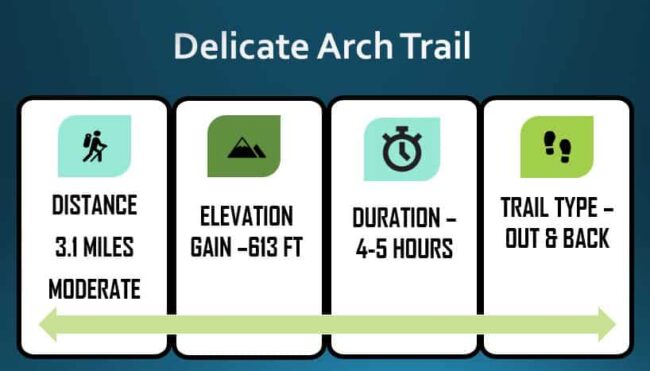
If you have the time and energy, the 3-mile round-trip hike to Delicate Arch is one of the most memorable experiences in the park. Plan for roughly 2–3 hours, bring plenty of water, and remember there is very little shade along the route. If you can’t make the hike, the viewpoint is still a worthwhile stop.
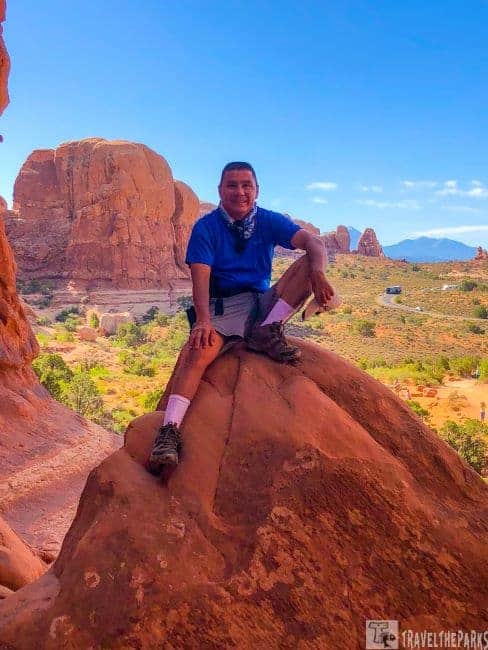
From the viewpoint, the arch looks smaller in the distance, but it is still an incredible sight. Bring binoculars if you have them—they help you appreciate just how massive this sandstone formation really is.
One detail we noticed while exploring was the pale blue tint in the soil near the viewpoint. Small details like this are part of what makes Arches so fascinating—the landscape is constantly telling the story of millions of years of geological change.

Wolfe Ranch
Before beginning the Delicate Arch Trail, take a few minutes to visit Wolfe Ranch. John Wesley Wolfe settled here in 1888 with his family, trying to build a life in this rugged desert landscape.
The simple one-room cabin, corral, and nearby remains offer a glimpse into how difficult it was for early settlers to live in what is now Arches National Park. It is hard to imagine farming and ranching in this environment, which makes their story even more fascinating.
Delicate Arch Trail: The Iconic Hike in Arches National Park
If you’re physically able, the Delicate Arch Trail is the hike that defines a visit to Arches National Park. The 3-mile round-trip trail includes about 480 feet of elevation gain, with almost no shade along the route. Much of the trail crosses exposed slickrock, and there are sections near the top with steep drop-offs that require careful footing.
We started our hike at 6:30 AM to beat the crowds and the heat. By the time we reached the arch, the early morning light was beginning to warm the sandstone. We sat on the slickrock, ate our granola bars, and watched other hikers arrive with the same expression we had—complete amazement at seeing this iconic formation in person.
Standing beneath Delicate Arch is an unforgettable experience. The arch measures 46 feet tall and 32 feet wide, and seeing it up close gives you a whole new appreciation for the scale of this landscape.
PRO Tip: Bring 2–3 liters of water per person and start early, especially during warmer months. The trail has very little shade, and parking at the trailhead can fill quickly.
Devil’s Garden
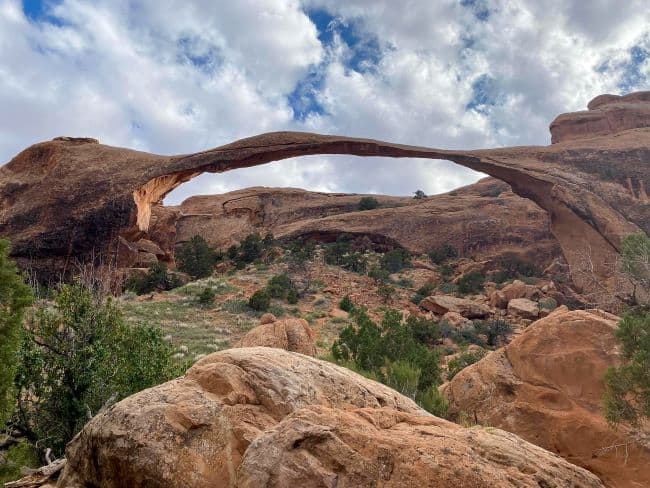
At the end of the scenic drive lies Devil’s Garden, and the name feels fitting for a landscape filled with towering fins, narrow passages, and challenging terrain. This area is home to some of the park’s most impressive arches, including Landscape Arch, one of the most incredible formations in Arches National Park.
The full Devil’s Garden Trail is about 8 miles round-trip if you complete the entire loop, but you don’t have to go that far to experience the highlights. We explored the shorter section that includes Landscape Arch, Navajo Arch, and Partition Arch, which still delivers incredible views and a taste of the adventure.
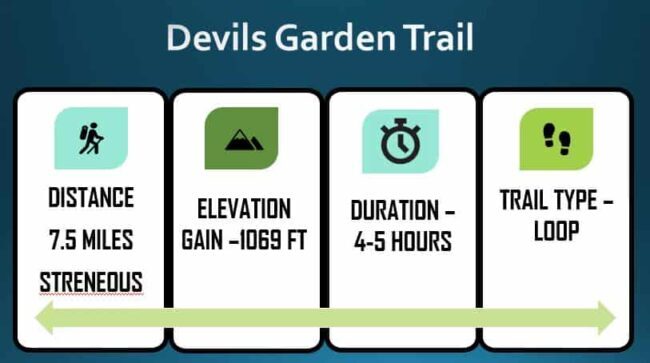
Even the shorter route requires some effort, with sections of scrambling, loose gravel, and slickrock where you’ll want good shoes and steady footing. But the payoff is absolutely worth it.
Landscape Arch is the star of the area—a massive ribbon of sandstone stretching about 290 feet across while appearing impossibly thin in places. Standing near it, you can’t help but wonder how something so delicate has survived for so long.
PRO Tip: Start early if Devil’s Garden is on your list. The trailhead parking lot fills quickly, and the morning light makes the sandstone formations even more dramatic.
Fiery Furnace: Arches National Park’s Sandstone Maze
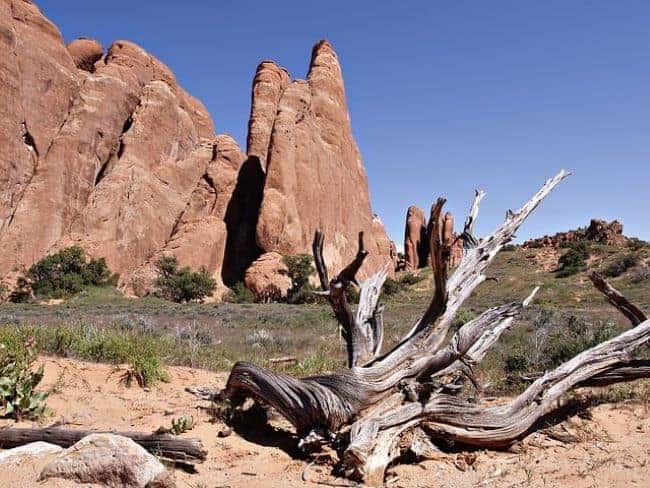
This is not your typical hike. The Fiery Furnace is a maze of narrow sandstone fins, twisting passages, and hidden corners that feels more like exploring a natural puzzle than following a traditional trail.

Visitors can explore the area through a ranger-led tour or with a self-guided permit. We opted for the self-guided option, and honestly? We got turned around a few times.
But that’s part of what makes the Fiery Furnace so memorable. Every twist and turn reveals something unexpected—a hidden arch, a narrow passage you have to squeeze through, or a viewpoint that makes you forget you were just wondering if you were headed the right way.
We downloaded a trail guide beforehand, which helped immensely. The route can be difficult to follow, the rock markings are not always obvious, and the terrain involves scrambling and uneven surfaces. Good shoes are a must, and this adventure is not ideal for visitors with mobility concerns.

The sandstone walls here are also some of the most vibrant in the park, with deep red and orange tones that seem to glow in the sunlight. The Fiery Furnace is part hike, part scavenger hunt, and completely different from anywhere else in Arches National Park.
PRO Tip: Plan ahead if you want to explore the Fiery Furnace. Permits from recreation.gov and ranger-led tours require advance planning, and this is one experience you don’t want to rush.
Arches National Park Visitor Center
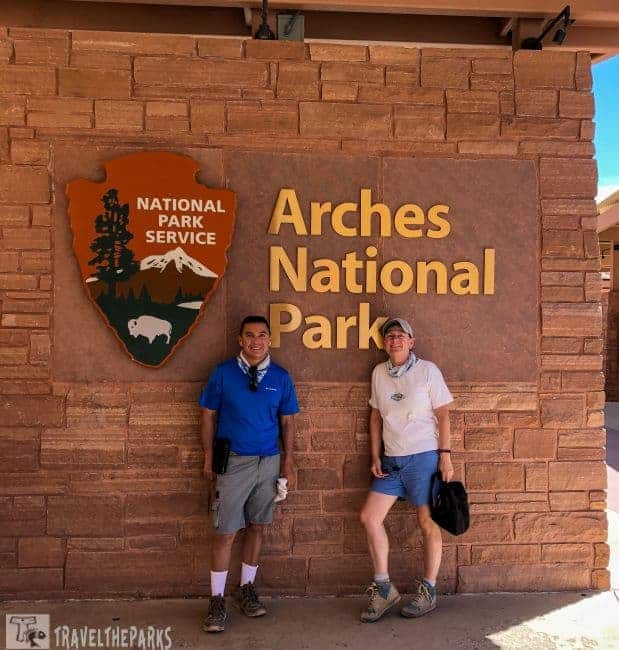
Located just inside the park entrance, the Visitor Center is a worthwhile first stop before starting your day. Here you can pick up trail maps, learn about the park’s geology and wildlife, and get current information from park rangers.
We recommend spending 15–20 minutes here to get your bearings and check for any trail conditions or updates. There is also a water refill station, which is especially helpful before heading into the desert where hydration is essential.
Where to Stay Near Arches National Park: Red Cliffs Lodge
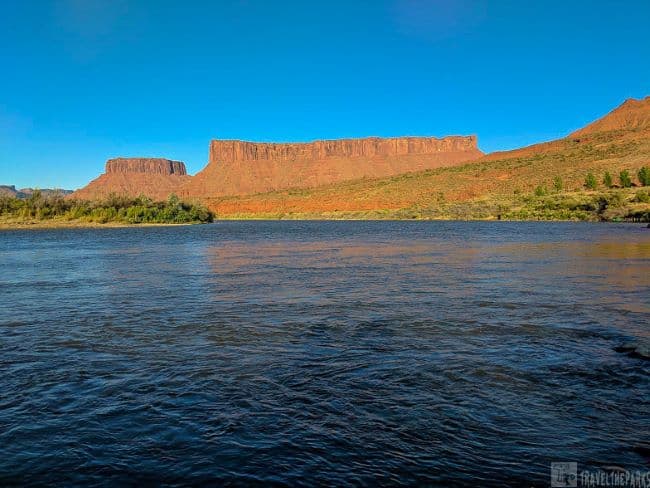
If you’re looking for a memorable place to stay near Arches National Park, Red Cliffs Lodge is one of our favorite recommendations. Located along the Colorado River on scenic Highway 128, the drive to the lodge is an experience itself. Towering red rock cliffs surround the road, and you’ll likely find yourself stopping often to take photos along the way.
Our Room: King Suite Riverside Room
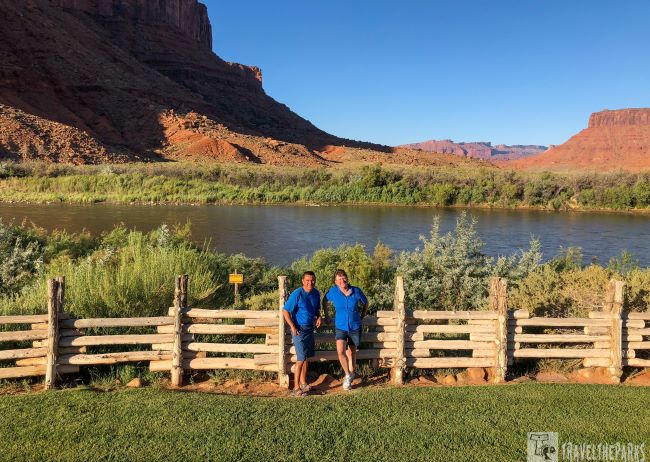
We stayed in the King Suite Riverside Room, which included a private patio overlooking the Colorado River. The view changed throughout the day as the sunlight moved across the cliffs—gold in the morning, deep orange and red in the afternoon, and purple tones as evening arrived.
The room also featured a kitchenette, a comfortable sitting area with a sofa, and one of the most relaxing beds we’ve experienced on our travels.

Castle Creek Winery
One of the unique features of staying at Red Cliffs Lodge is having Castle Creek Winery right on the property. Guests can enjoy wine tastings, and we picked up a bottle of Outlaw Red to take home. They also offer local products, including cheeses, crackers, and souvenirs.

Cowboy Grille
Dinner at the Cowboy Grille was one of the highlights of our stay. The menu offers creative dishes, the service was excellent, and the views make the experience even better.
We started with the Ceviche Southwest before enjoying elk medallions and pork chops for our main courses. Both were memorable meals after a full day exploring Arches.

Moab Museum of Film and Western Heritage
Located downstairs from the lodge lobby, this small museum is an unexpected bonus for guests. It highlights Moab’s history as a filming location, featuring movies such as Wagon Master, Rio Bravo, and Thelma and Louise. Fans of classic Westerns and John Wayne will especially enjoy the exhibits.
Final Thoughts: One Day in Arches National Park
There is something about Arches National Park that stays with you long after you’ve left. Maybe it’s the way the sunlight transforms the sandstone formations throughout the day. Maybe it’s the quiet of the desert, broken only by the wind and the occasional bird. Or maybe it’s the wonder of seeing how millions of years of erosion created a landscape that feels almost impossible.
One day in Arches National Park may not be enough to see everything, but it is more than enough to understand why this place is so special. The towering fins, massive arches, and endless desert views have a way of making you feel small in the best possible way—and they will likely leave you planning your next visit before you even leave.
Our Final Tip: Bring more water than you think you’ll need, start your day early, and slow down long enough to appreciate the silence of the desert. The views are incredible, but some of the best moments in Arches come from simply standing still and taking it all in.
What was your favorite experience in Arches National Park? Was it standing beneath Delicate Arch, exploring the Windows Section, or discovering a hidden corner of the park? Share your favorite moment in the comments below—we’d love to hear about it.