Grand Canyon National Park South Rim had always been at the top of our bucket list. From Cameron, Arizona, it was an easy drive to the park, where spectacular viewpoints seemed to put us right on the edge of one of the most incredible landscapes we had ever seen. This was the final national park stop on our Grand Circle Tour., and we had high hopes that the South Rim would be just as distinctive as Zion and Bryce National Parks.
As we made our way into the park, we quickly realized the Grand Canyon was going to be a memorable way to finish our Southwest road trip.
This post may contain affiliate links, meaning if you purchase something through one of these links, we may earn a small commission at no extra cost to you! Read the full disclosure policy here.
Table of Contents
Starting Your Grand Canyon South Rim Visit from Cameron, Arizona
The historic Cameron Trading Post was our overnight stop on the way from Monument Valley to Grand Canyon National Park South Rim. Dating back to the early 1900s, this legendary trading post makes a convenient base for exploring the area.
We stayed one night in a room at the back of the hotel. It was clean and quiet, with a view of the Little Colorado Gorge. The hotel is older, and the A/C fan rattled a bit, but we slept well. Dinner at the restaurant was good, and the specialty is the Navajo taco. Just be warned—it is a lot of food for one person! We recommend splitting one between two people, and the restaurant will even cut it in half.
The gift shop is enormous, with a large selection of Native American arts and crafts. Because Cameron Trading Post is a popular stop for tour buses, it can get crowded, especially around the gift shop.
We were up early the next morning and skipped breakfast since the restaurant didn’t open until 6 a.m. Instead, we headed toward the East Entrance of Grand Canyon National Park South Rim along scenic Highway 64. The drive took a little over an hour, and at that early hour, we practically had the road to ourselves.
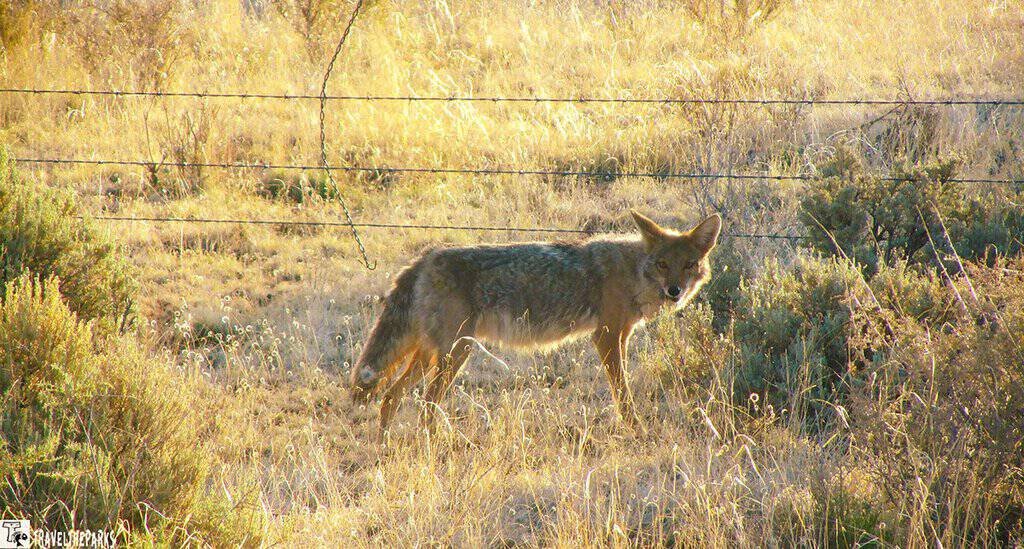
The sunrise was spectacular. Then, just before entering the park, something unexpected happened: a coyote ran across the highway in front of us, grabbed a dead rabbit from the road, and carried it to the side to eat. I managed to capture video of the coyote, making an already beautiful morning even more memorable.
Know Before You Go: Grand Canyon National Park South Rim
- Entrance Fees & Passes: The standard entrance fee is currently $20–$35, depending on the type of entry. Admission is valid for seven days and includes the South Rim. The park is cashless, so plan to pay by credit or debit card or use a digital or America the Beautiful pass. If you are visiting several national parks during a road trip, an America the Beautiful can be a good value. Check current Grand Canyon entrance fees and passes
- Important 2026 update: Beginning January 1, 2026, visitors who are not U.S. residents and are age 16 or older must pay an additional $100 nonresident fee, unless they have an America the Beautiful Non-Resident Annual Pass.
- Operating Hours: The South Rim is open year-round, 24 hours a day, although visitor centers, facilities, and shuttle schedules vary by season.
- Parking & Shuttles: Arrive early if you want easier parking near popular viewpoints such as Mather Point. Free shuttle buses connect major areas of the South Rim, with routes varying by season.
- In 2026, the Hermit Road shuttle operates seasonally, and Hermit Road is closed to private vehicles from March 1 through November 30.
- Pets: Leashed pets are allowed on trails above the canyon rim, in developed areas, and at designated campgrounds. Pets are not permitted below the rim on inner-canyon trails or on park shuttle buses.
- Maps & Visitor Information: Free park maps are available at entrance stations, visitor centers, lodges, campgrounds, and other locations. The NPS also provides current South Rim maps, shuttle information, road conditions, and trip-planning information online.
- What to Bring: Wear sturdy walking or hiking shoes, particularly if you plan to leave the paved rim viewpoints and venture onto canyon trails. Bring plenty of water, snacks, sun protection, and a refillable water bottle. Trekking poles can also be helpful on steep or uneven trails. Grand Canyon temperatures can vary dramatically with elevation, and summer heat can be particularly demanding once you descend below the rim.
Must-See Stops Along Desert View Drive
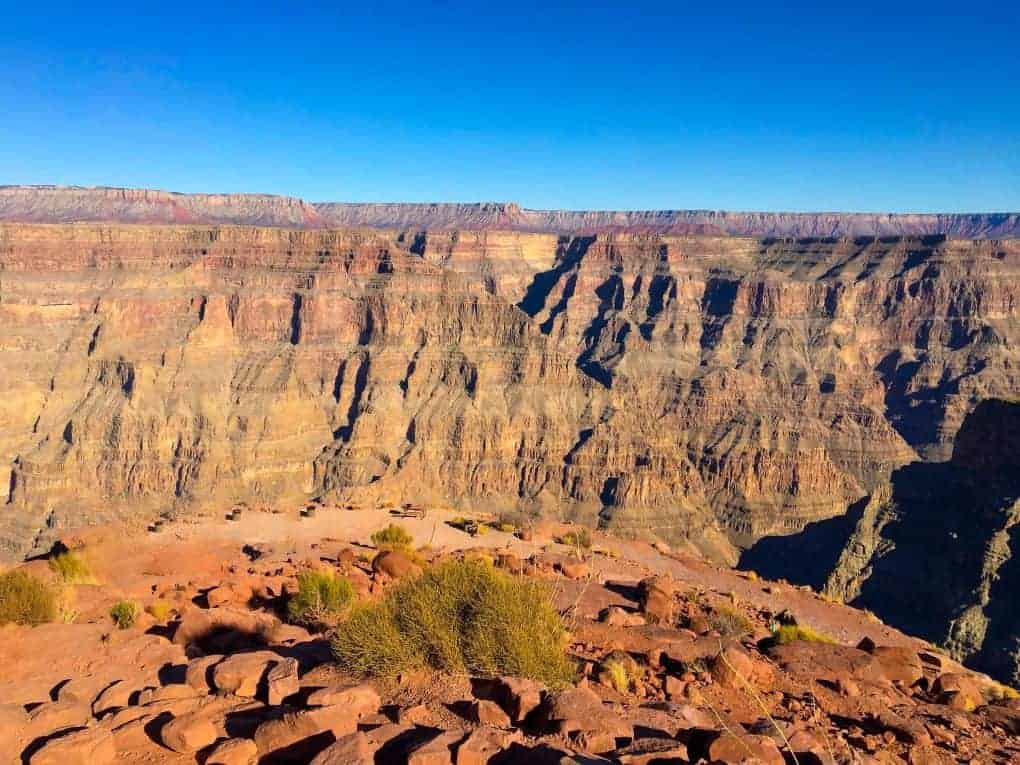
One of the best ways to begin exploring the Grand Canyon National Park South Rim is along Desert View Drive. The scenic road stretches 23 miles between Grand Canyon Village and Desert View, following the South Rim with numerous viewpoints and pullouts along the way.
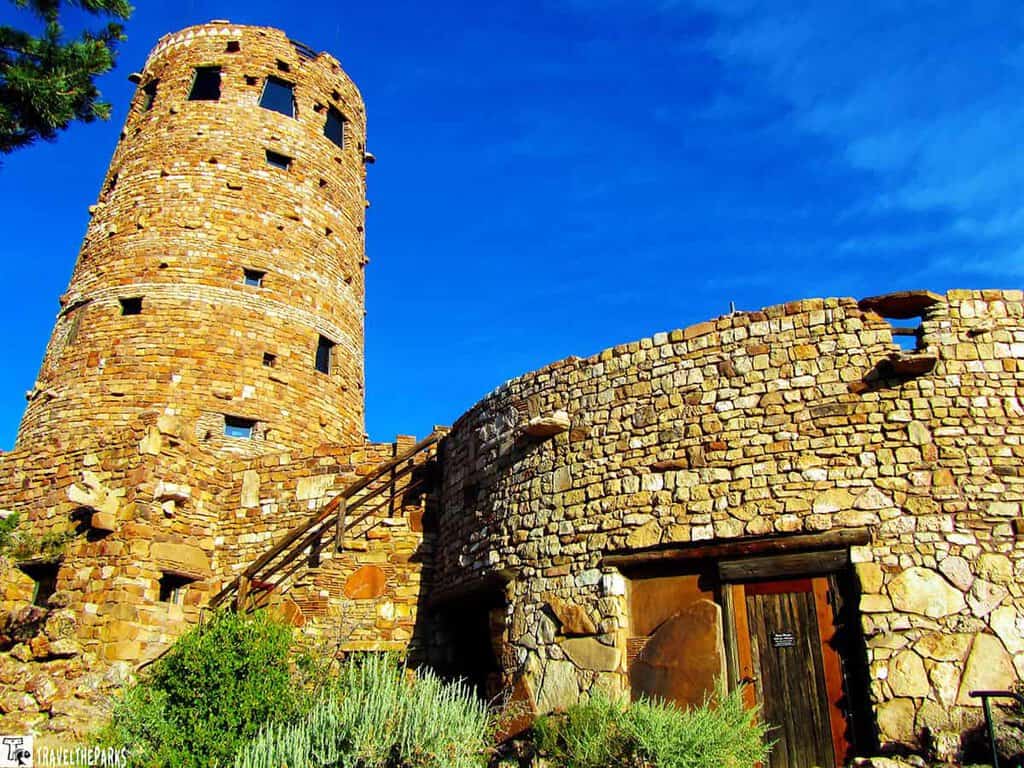
For us, the first stop was Desert View Point and the historic Desert View Watchtower , sitting at an elevation of 7,438 feet. We arrived early and parked in the large parking area before walking toward the canyon rim. The pathways were surrounded by native vegetation, and we enjoyed watching ground squirrels nibbling on seeds along the way.
As we reached the canyon’s edge, the views were spectacular. Because we had arrived so early, there were very few other visitors around, and for a little while, it felt as though we had the place to ourselves. The Watchtower itself was still closed during our visit, so we weren’t able to see the interior.
Even from the outside, the Desert View Watchtower is impressive. Designed by architect Mary Colter and completed in 1932, the four-story structure was inspired by the architecture of Ancestral Puebloan peoples of the Colorado Plateau. Today, the Watchtower is recognized as a National Historic Landmark.
The tower was designed to blend into its surroundings while providing visitors with spectacular views. From Desert View, the Colorado River makes a dramatic bend through the canyon, while distant views extend toward the Painted Desert and the San Francisco Peaks.
Can You Go Inside Desert View Watchtower?
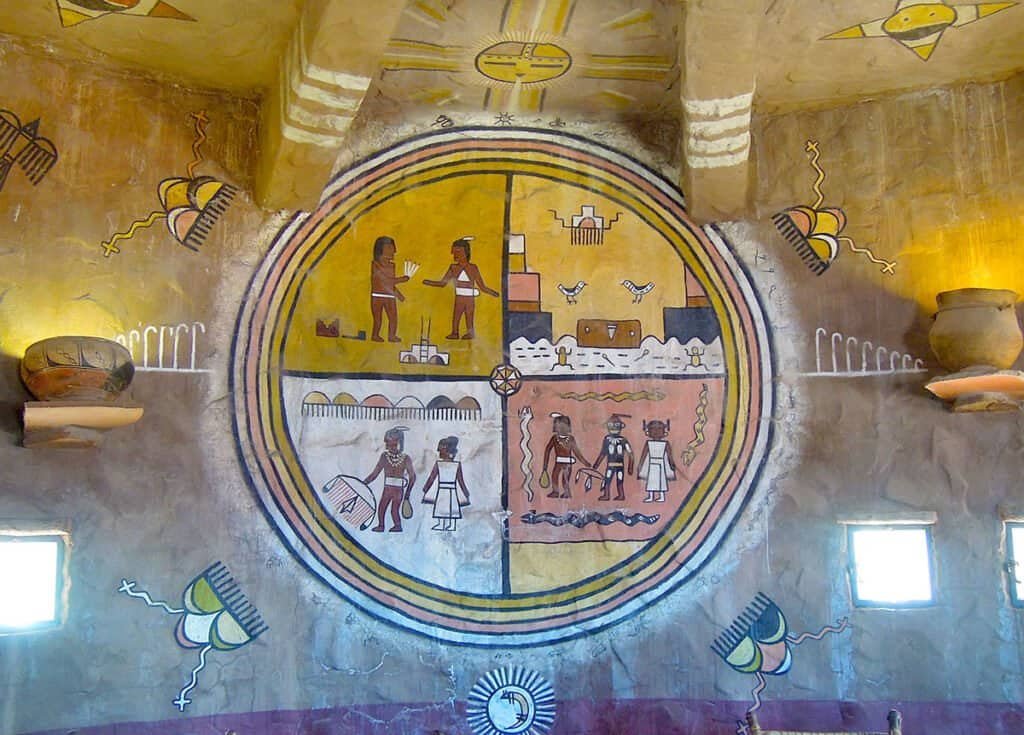
If you’re visiting today, you may be able to explore more of the Watchtower than we did. The ground-level View Room is open, and when staffing allows, visitors can access the upper floors using a free, first-come, first-served ticket. Capacity is limited to 25 people at a time, with a 20-minute time limit.
So, if seeing the inside of the Watchtower is important to you, check the current operating information when you arrive rather than assuming it will be open.
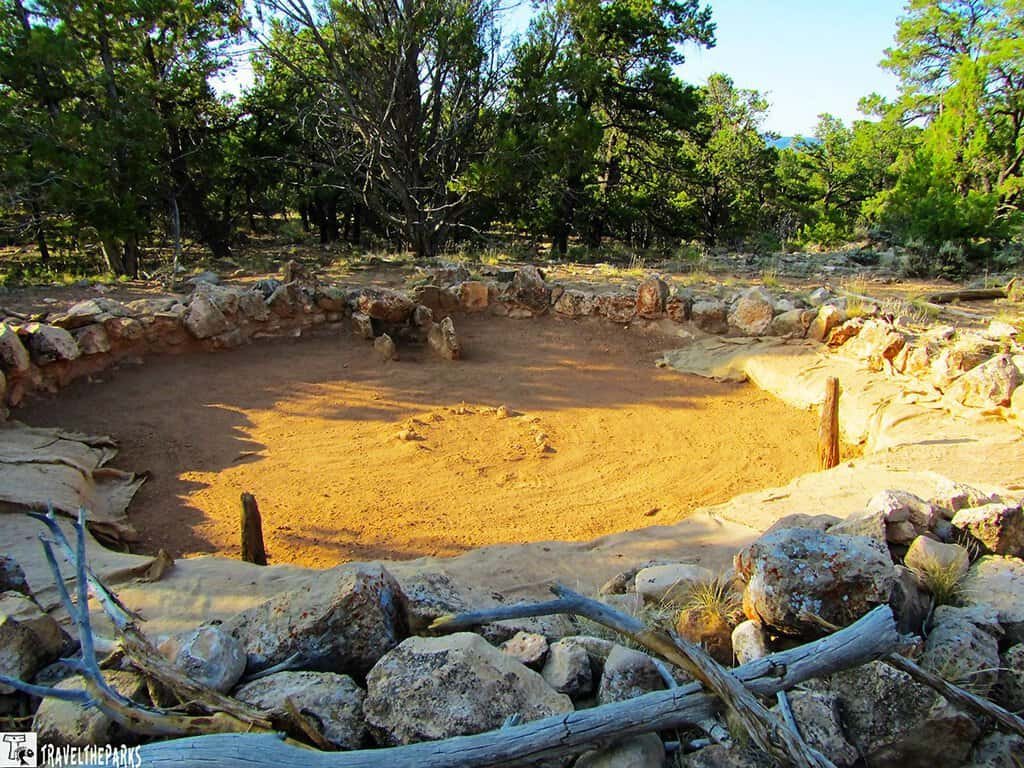
Tusayan Pueblo: A Glimpse Into Grand Canyon’s Past
As we continued along Desert View Drive, the road was still wonderfully quiet. We could stop at the viewpoints without dealing with the crowds we would encounter later around the South Rim Visitor Center and Grand Canyon Village.
Our next stop was Tusayan Pueblo, the remains of a small Ancestral Puebloan community near the canyon rim. When we visited, we arrived early enough that the museum was still closed, but we could explore the ruins.
The site isn’t large, but we enjoyed the peaceful walk through the ancient village. Interpretive signs along the trail helped explain what we were seeing as we walked among the stone structures. There is a large kiva, several rooms that once formed part of the village, a smaller kiva, and an area believed to have been used for storing food.
Walking through the ruins gave us a better appreciation for the people who lived on this plateau hundreds of years ago. It was more than just a collection of old stone walls—it was once a community overlooking the Grand Canyon.
If archaeology and history interest you, Tusayan Pueblo is an easy stop to add to a Desert View Drive itinerary. There are also shaded picnic tables and restrooms nearby.
2026 Update: The Tusayan Museum is currently closed until further notice, although the pueblo site is available seasonally. Check current NPS information before planning your visit.
Simply Beautiful Grandview Point
The parking lot at Grandview Point is easy to access, with paved walkways leading toward the overlook. A short walk brought us to Grandview Point, at about 7,400 feet, where the canyon seemed to stretch endlessly in front of us. The point juts out into the canyon, creating sweeping views in several directions.
Morning and sunrise are especially beautiful here. Tall pine trees do block the view in a few places, but honestly, there didn’t seem to be a bad view anywhere along the South Rim.
I was especially excited to spot my first Abert’s squirrel (Sciurus aberti) sitting beneath a picnic table. Those little tufts of fur on their ears make them especially cute!
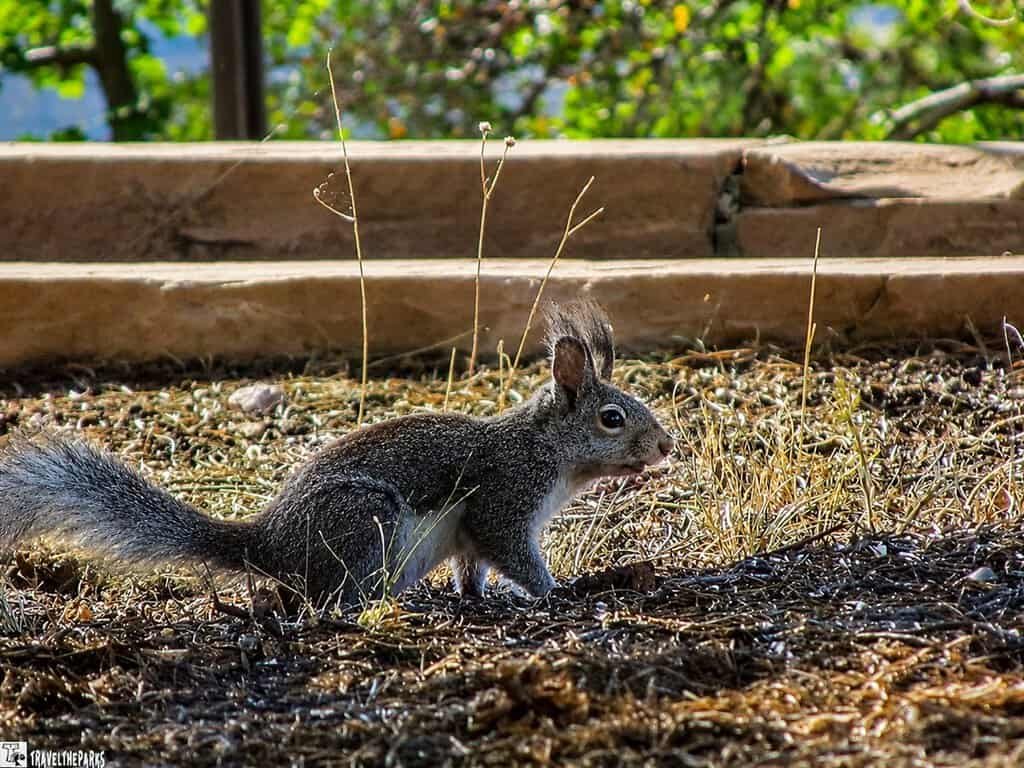
The interpretive signs at Grandview Point also tell an interesting story about the area’s early mining history. Around the turn of the 20th century, prospectors came to the Grand Canyon looking for copper, silver, and gold. One of them, Pete Berry, established the Last Chance Mine and built the Berry Cabin and a hotel near Grandview.
If you have the time and are prepared for a steep hike, the trail into the canyon leads toward the remains of the Last Chance Mine on Horseshoe Mesa. The descent becomes steep quickly, so this isn’t a hike to attempt casually. Remember that whatever you hike down, you’ll eventually have to climb back up.
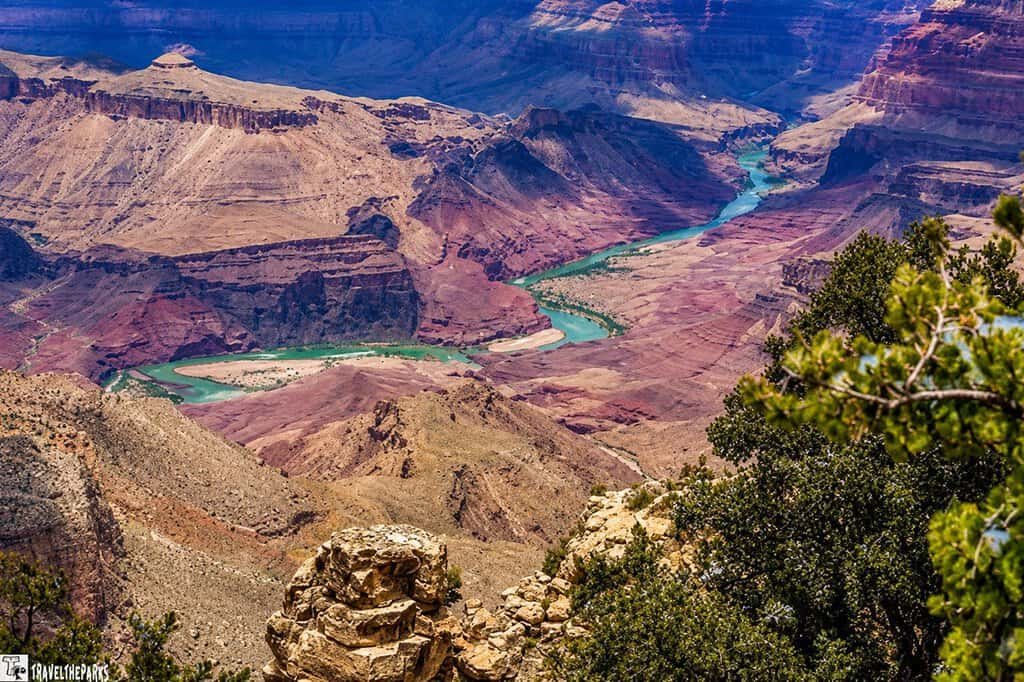
Best Places for Sunrise and Sunset at the South Rim
One of the best things about the Grand Canyon is that the view changes constantly with the light. Sunrise and sunset can turn the canyon walls from muted reds and browns into brilliant shades of orange, pink, and purple.
For sunrise, we especially liked Yaki Point, while Mather Point and Yavapai Point are also good choices. For sunset, we preferred Pima Point, Mohave Point, and Hopi Point. The National Park Service also recommends Mather and Yaki Points for sunrise, with Hopi Point being especially popular at sunset.
If you want to catch sunrise, plan to arrive before the sun reaches the canyon. The NPS recommends getting to your chosen viewpoint about 30 minutes before sunrise and staying afterward to watch the changing light.
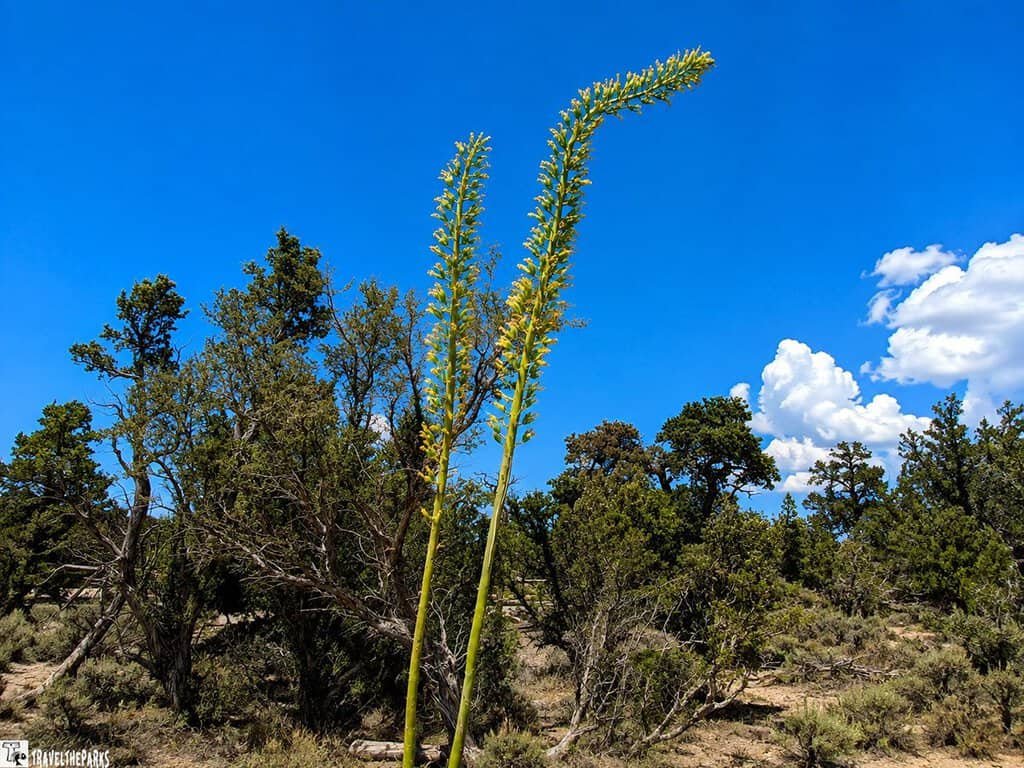
Sunrise at Yaki Point
Yaki Point is one of our favorite places for sunrise. You can’t drive directly to the viewpoint, so you’ll need to use the free Kaibab Rim (Orange) Route shuttle, walk, or bicycle. The road to Yaki Point and the South Kaibab Trailhead is closed to private vehicles.
The views from Yaki Point are far-reaching, and words really don’t do them justice. We arrived in time to watch the canyon slowly brighten as the sun came up. It was one of those Grand Canyon moments that photographs simply can’t capture.
The South Kaibab Trailhead is nearby, making Yaki Point a convenient starting point if you want to combine sunrise with a short hike below the rim.
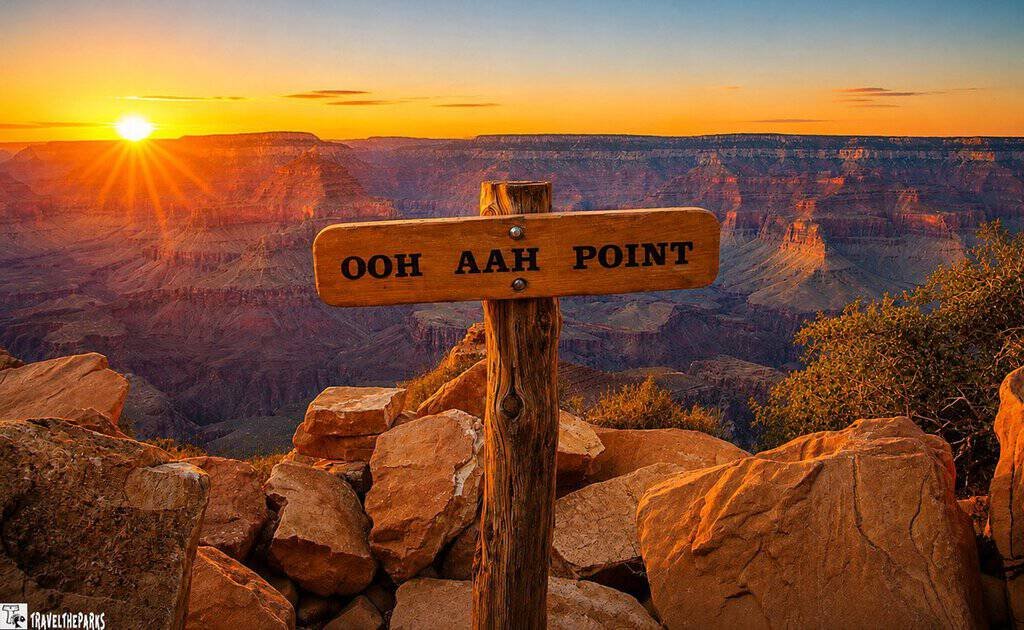
Hike to Ooh Aah Point for Sunrise
The South Kaibab Trail to Ooh Aah Point was one of the most breathtaking hikes we did at the Grand Canyon. When we visited, the round trip was about 1.8 miles, and it took us roughly 25 minutes to reach Ooh Aah Point in time for sunrise.
The trail down felt relatively easy, with plenty of morning shade along the switchbacks. The views became more impressive with every turn, and once we got below the rim, we gained a whole new appreciation for the enormous scale of the canyon.
Of course, coming back up was another story.
For us, the struggle was real. We stopped frequently to catch our breath and take pictures, which turned out to be a good excuse to pause and enjoy the scenery. The climb is a reminder that hiking into the Grand Canyon is very different from hiking on level ground. You have to earn every foot of elevation you regain.
The changing sunlight made the effort worthwhile. As the sun moved higher, the colors and shadows across the canyon walls changed right before our eyes.
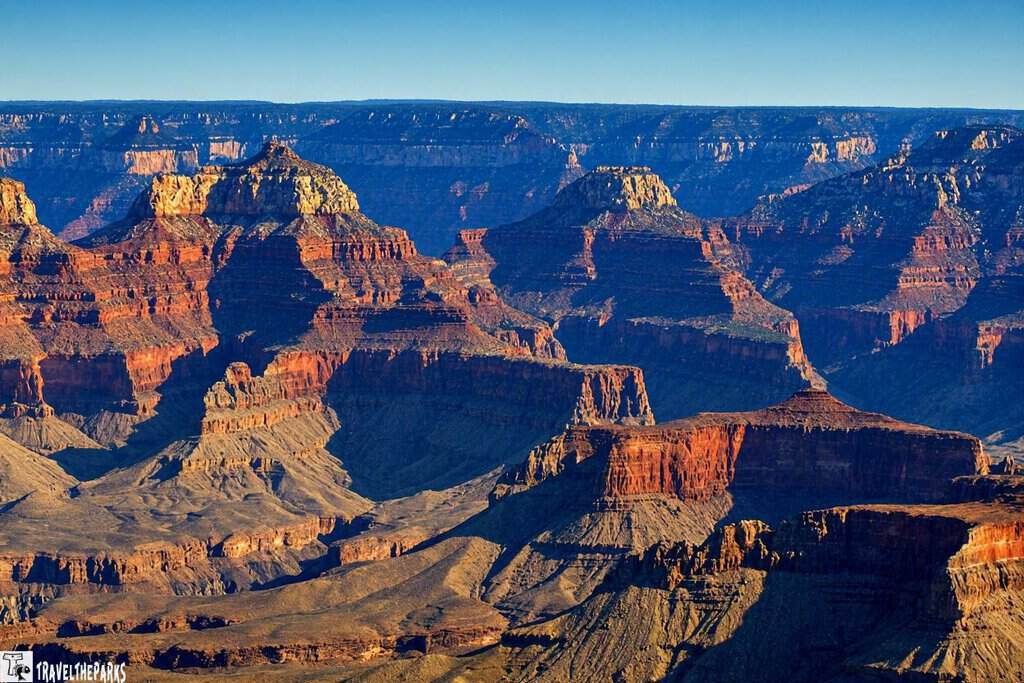
A Few Things to Know Before Hiking Below the Rim
Don’t underestimate the return trip. The South Rim sits at roughly 7,000 feet, and hiking uphill at this elevation can be strenuous. Bring plenty of water, wear shoes with good traction, and give yourself plenty of time to make the climb back out.
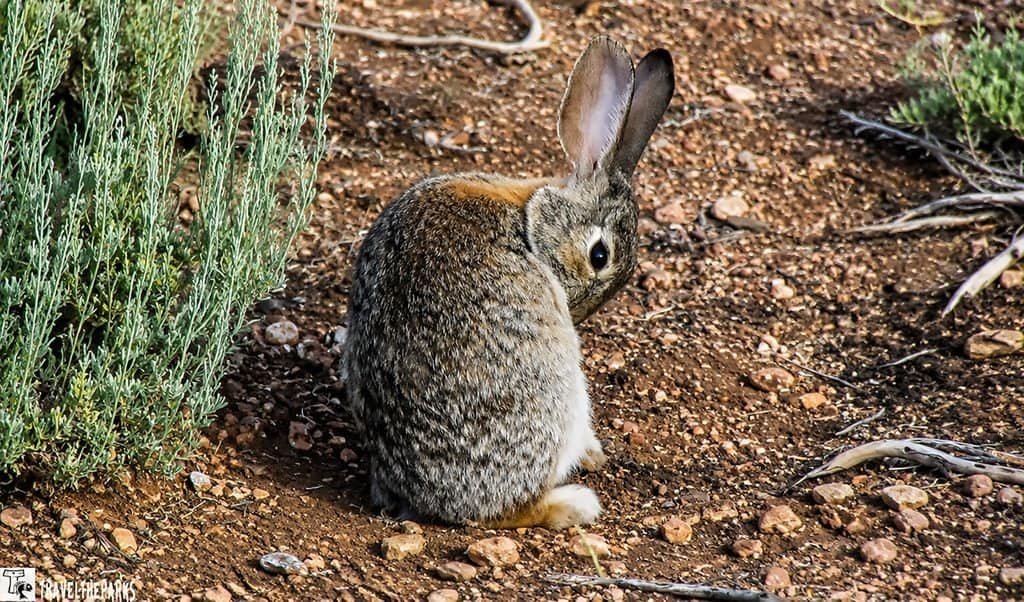
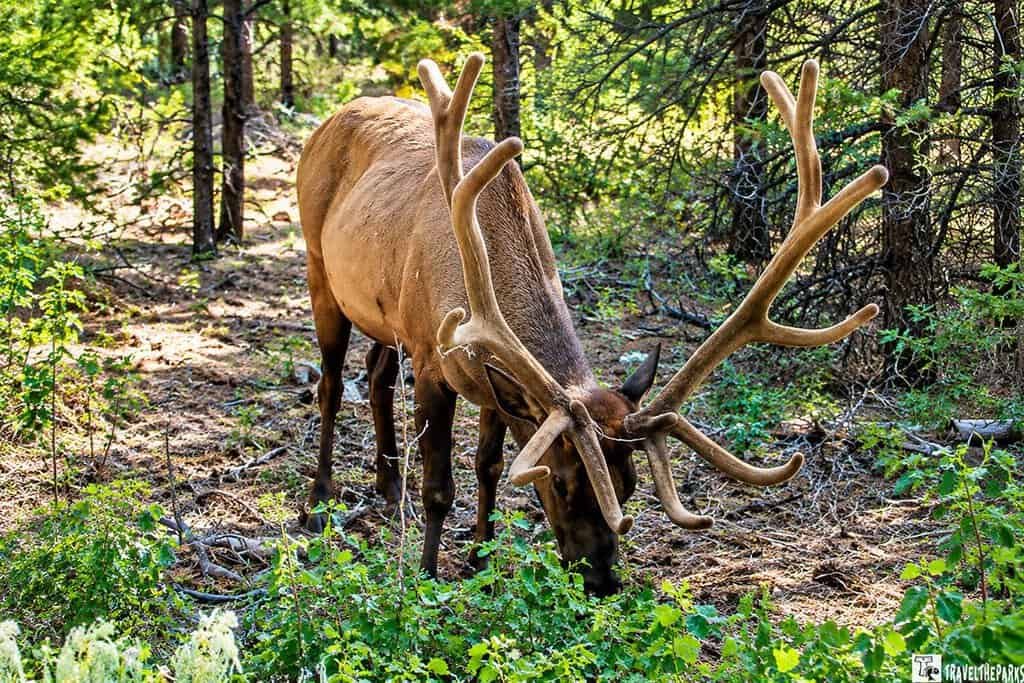
We also saw plenty of wildlife along the road between Yaki Point and the Visitor Center, including a huge male elk munching on vegetation beside the road. I managed to get some great video before continuing toward Grand Canyon Village.
Staying at Bright Angel Lodge on the South Rim
Tonight, we had a reservation at Bright Angel Lodge., where we had booked a rustic rim cabin for one night. We made the reservation a year in advance, which gives you an idea of how popular staying right along the canyon rim can be.
Bright Angel Lodge has a long history at the South Rim. The property began with a cabin and several tents in 1896, and the lodge’s central building was designed by Mary Jane Colter in 1935.
Parking was limited, so we had read that once we found a spot, it was best to leave the car parked and walk whenever possible. That turned out to be good advice. Our cabin didn’t have a canyon view, but we were only steps from the rim and within easy walking distance of the Bright Angel Trailhead, park shuttle, ice cream shop, and other Grand Canyon Village amenities.
Despite being so close to the busy Rim Trail, our cabin felt surprisingly private and peaceful. We didn’t hear much outside noise, which made it a wonderful place to spend the night.
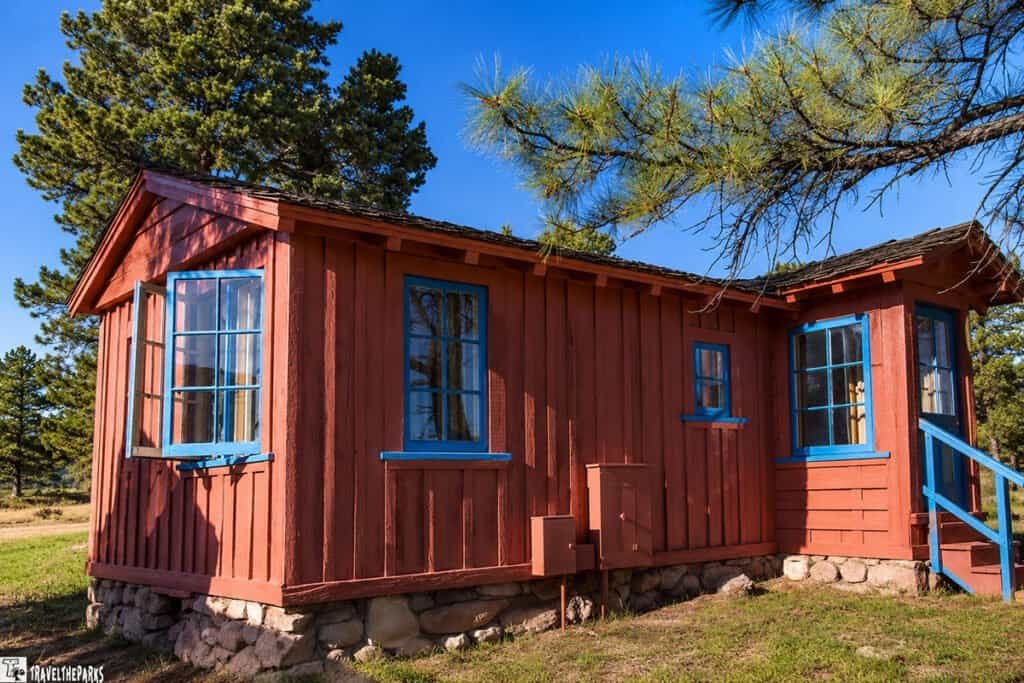
Our Bright Angel Lodge Rim Cabin
The cabin was small but spotless, with a large bed, a small full bathroom, and a ceiling fan. There was no Wi-Fi or cell service in the cabin during our stay, but honestly, being disconnected wasn’t a bad thing at the Grand Canyon.
There was also no air conditioning. During the day, we kept the curtains closed, then opened the windows in the evening when the desert air cooled down. With the ceiling fan running, the cabin became comfortable enough for a good night’s sleep.
The staff were professional and welcoming, and we were even able to check in early. We also found the park employees we encountered, from shuttle drivers to restaurant staff, to be friendly and helpful throughout our stay.
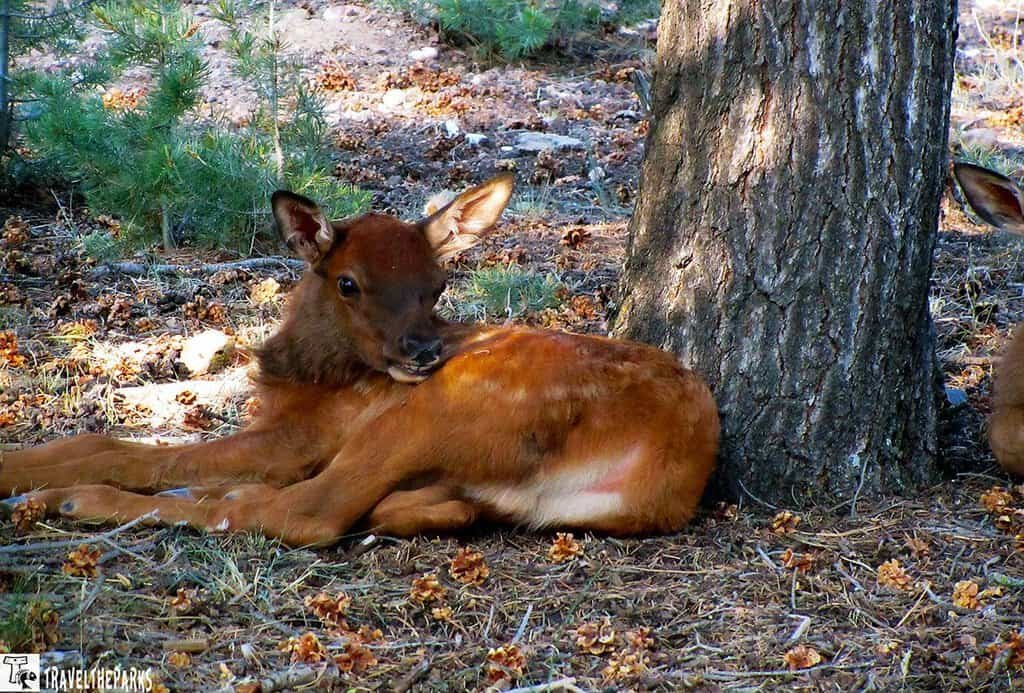
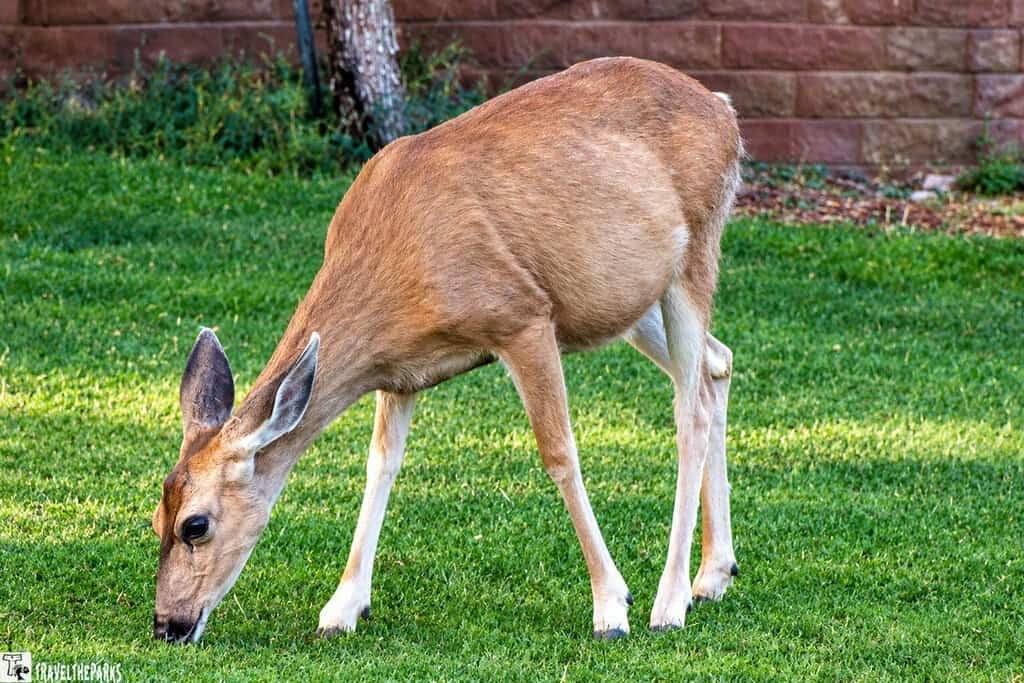
For me, one of the best parts of staying at Bright Angel Lodge was being so close to the wildlife. The next morning, we were awakened by the bugling of elk rather than an alarm clock. Watching the herd around the lodge made staying right on the rim feel even more special.
2026 Update: Bright Angel Lodge continues to offer historic lodging on the South Rim. Because room types, amenities, availability, and policies can change, check the current lodging information before making reservations.
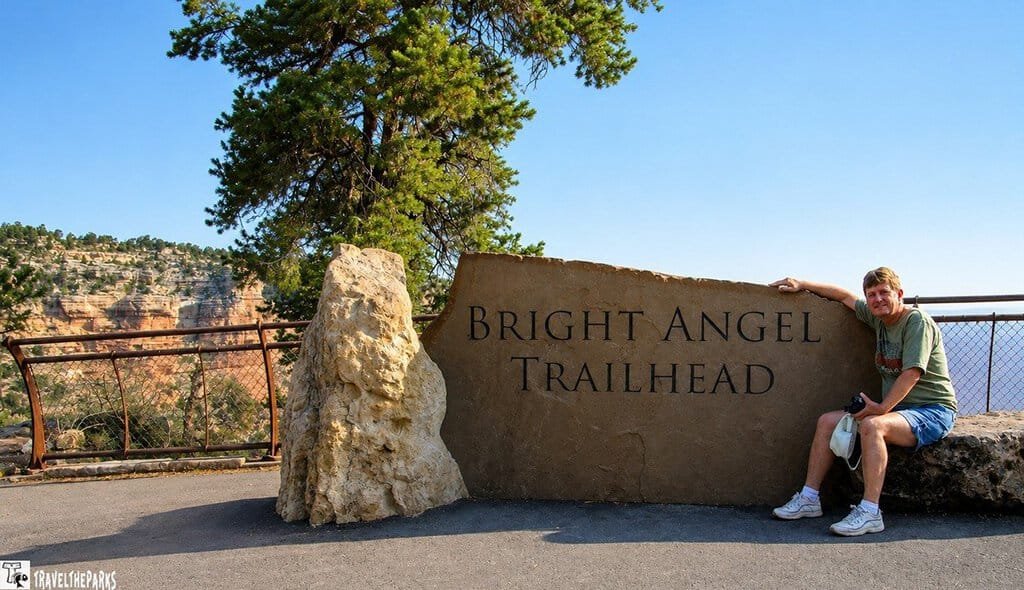
Hike Down the Bright Angel Trail
The Bright Angel Trailhead was only about 100 feet from our rim cabin, so we couldn’t resist taking a hike down into the canyon. It was later in the afternoon when we headed out, and we decided to walk as far as Indian Garden before turning around.
The trail is also used by the mule trains heading toward Phantom Ranch, and it’s fairly wide in this section. One thing you quickly learn is to watch where you’re stepping—there were plenty of mule droppings along the trail!
We found the switchbacks made the descent manageable, but the farther down we went, the more we appreciated just how enormous the canyon really is. Looking back toward the rim gave us an entirely different perspective than the views we’d seen from above.
At the time of our visit, Indian Garden was our turnaround point. Today, it is known as Havasupai Gardens. The trail continues farther into the canyon toward Plateau Point and the Colorado River, but those longer hikes require considerably more time and preparation.
A Few Things to Remember Before Hiking the Bright Angel Trail
Three things come to mind whenever I think about this hike. First, be realistic about your fitness level. Going down may feel relatively easy, but remember that every step down eventually becomes a step back up. The elevation and steep switchbacks can take their toll.
Second, pay close attention to the weather and temperature. When we did this hike, temperatures were approaching 107°F. The heat made the climb back to the rim much harder than the descent.
Finally, take plenty of water, start early when possible, and give yourself plenty of time. Don’t let the fact that you can easily walk down convince you that the return trip will be just as easy.
I would love to come back someday and hike farther into the canyon toward Phantom Ranch. For this visit, though, turning around when we did was the right decision.
Three important facts come to mind if you plan to do this trial. First, make sure you are physically fit. The switch backs help, but the elevation can take its toll. Watch the weather and temperature make all the difference to the enjoyment of this hike. Today the temps are nearing 107 degrees. I would like to return and do the hike to Phantom Ranch the next time we visit.
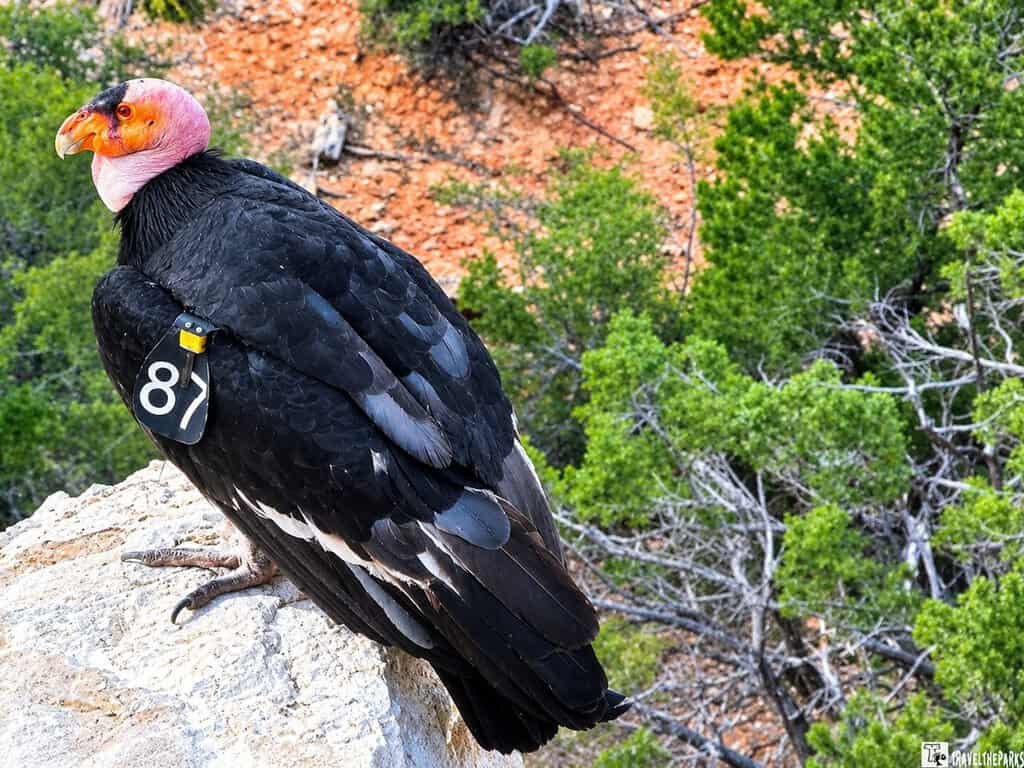
Look for California Condors
Another highlight of our evening was spotting California condors perched along the canyon cliffs. We were lucky enough to see several of these impressive birds and were able to get some great photographs.
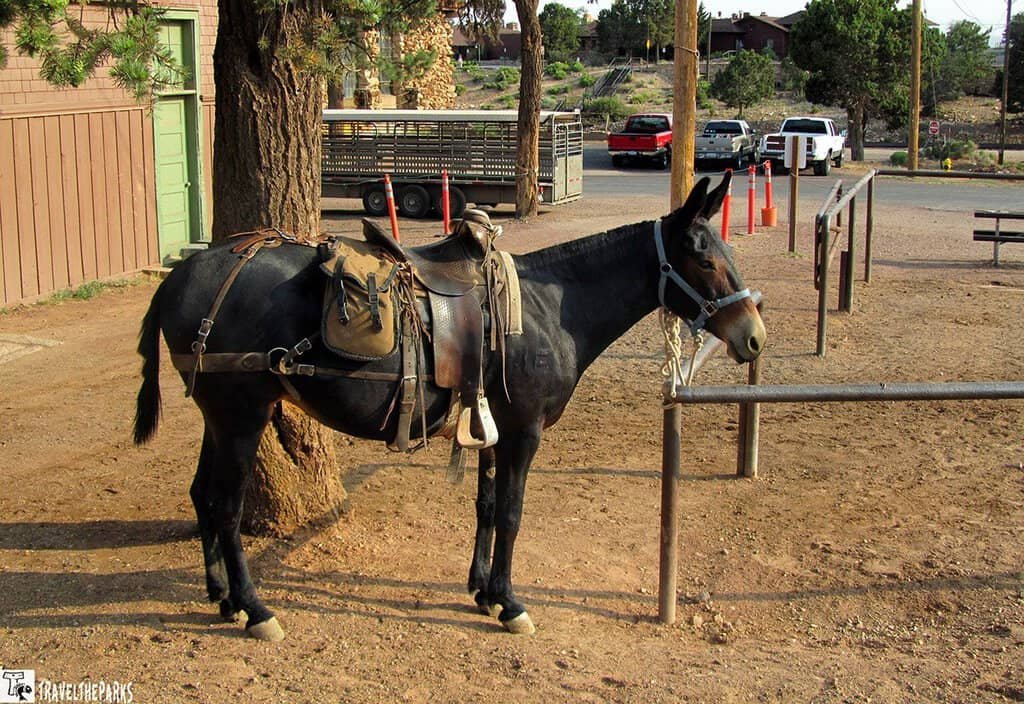
If you have some extra time around Grand Canyon Village, take a quick walk over to the mule barn and nearby livery stable. These historic buildings were important parts of the early village, back when horses and mules were essential for getting around the Grand Canyon.
The mule barn was still an active part of the village when we visited. We enjoyed watching the mules lined up along the fence, and you could even walk over and pet them. Seeing the animals that carry visitors into the canyon made us think about trying a mule ride ourselves.
Maybe next time!
Best Viewpoints Along Hermit Road
In the afternoon, we headed out to explore Hermit Road. When we visited, we took the shuttle to Powell Point and then walked along the Rim Trail toward Hermits Rest. This turned out to be a great way to experience this section of the South Rim because the canyon seemed to change with every viewpoint.
Today, Hermit Road is closed to private vehicles during the main visitor season, and shuttle service provides access to the overlooks. You can also walk or bicycle the road. The shuttle makes it easy to get off at one viewpoint, enjoy the scenery, and continue on to the next. Check the current NPS shuttle schedule before your visit because operating times change throughout the year.
Popular Powell Point
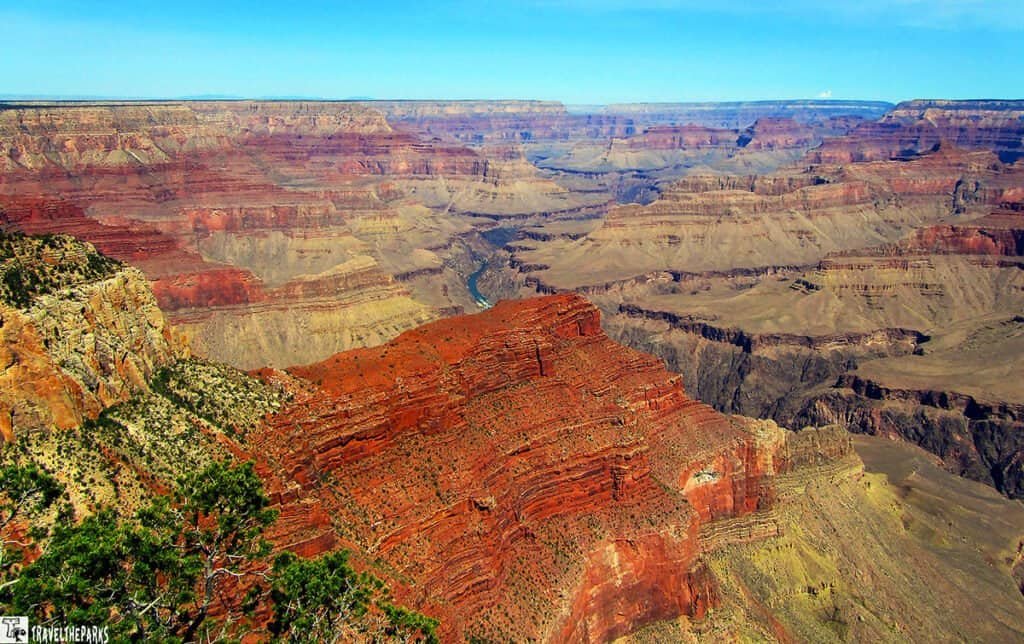
We got off the shuttle at Powell Point, where a granite memorial honors John Wesley Powell and his explorations of the Colorado River. Powell’s expeditions through the canyon must have been an incredible undertaking. Standing there and looking down at the river, I couldn’t help wondering what it must have been like to navigate those rapids with so little knowledge of what lay ahead.
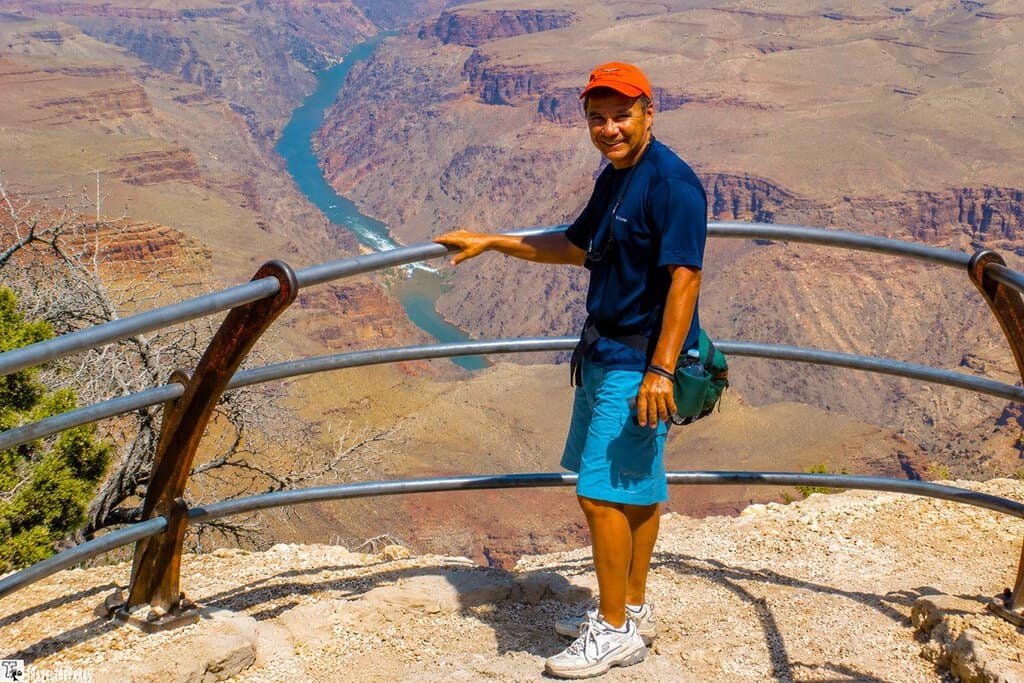
Powell Point offers expansive views into the canyon, with the Colorado River visible far below. We took our time here before continuing along the Rim Trail.
Hopi Point: A Favorite for Sunset
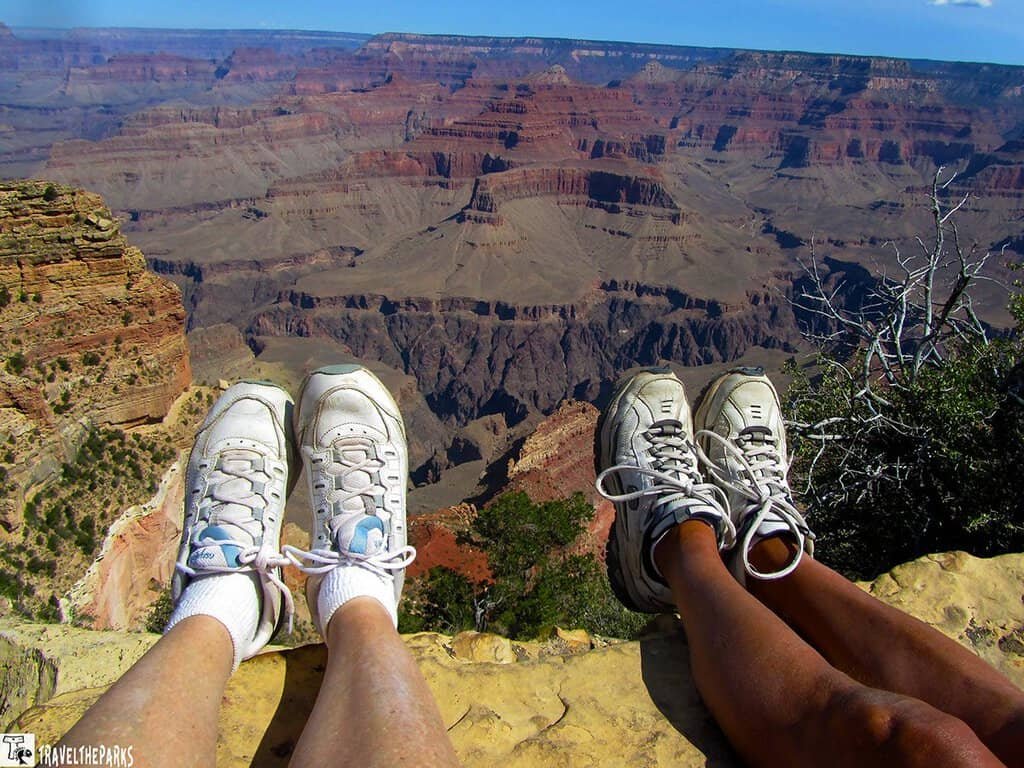
Hopi Point is one of the most popular places along the South Rim for watching the sun go down. Early visitors and entrepreneurs recognized the appeal of this stretch of rim, and today it remains a favorite place to stop and take in the scenery.
From Hopi Point, we could see the Colorado River winding through the canyon below. I took plenty of panoramic photographs and enjoyed getting different perspectives from the overlook.
We had planned to walk farther along the rim, but the high temperatures changed our plans. Instead, we decided to use the shuttle to reach the remaining viewpoints and eventually Hermits Rest.
Mohave Point: Views of the Colorado River
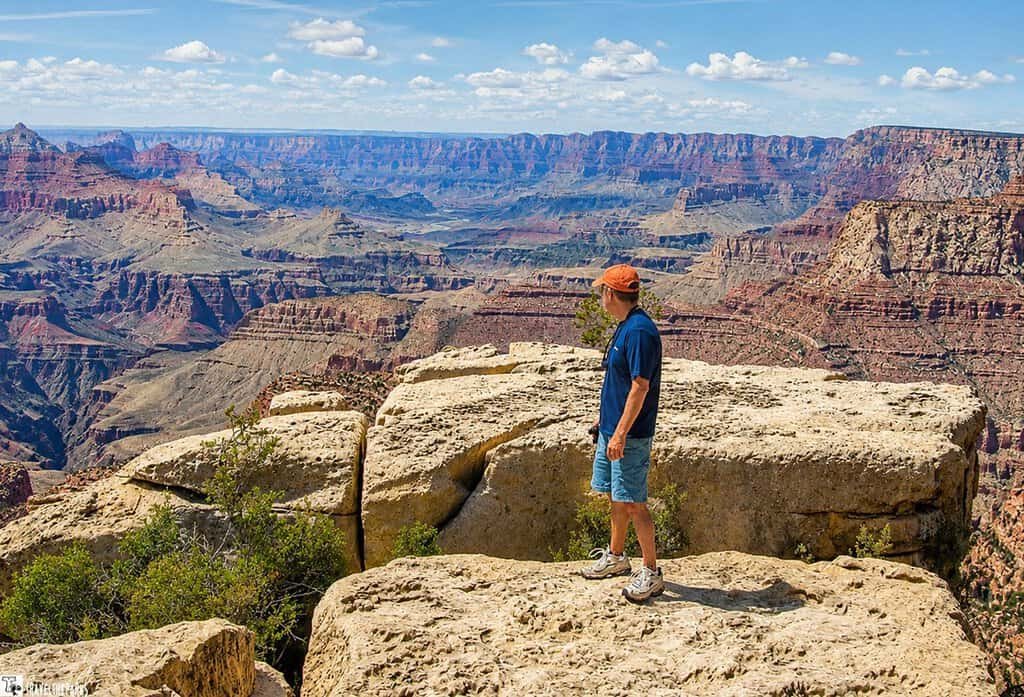
Mohave Point was another impressive stop along our walk. In places, you feel remarkably close to the canyon edge, and the views seem to stretch in every direction.
The Colorado River and Hermit Rapids are visible below, while the distinctive red sandstone formations add even more character to the view. We also enjoyed the opportunity to take photographs from several different angles.
The farther west we traveled, the fewer people we encountered. That made this part of the route especially enjoyable.
One word of advice: be careful near the canyon edge. We saw people getting dangerously close while trying to capture the perfect photograph. No picture is worth taking a needless risk at the Grand Canyon.
Pima Point: Listen for the Colorado River
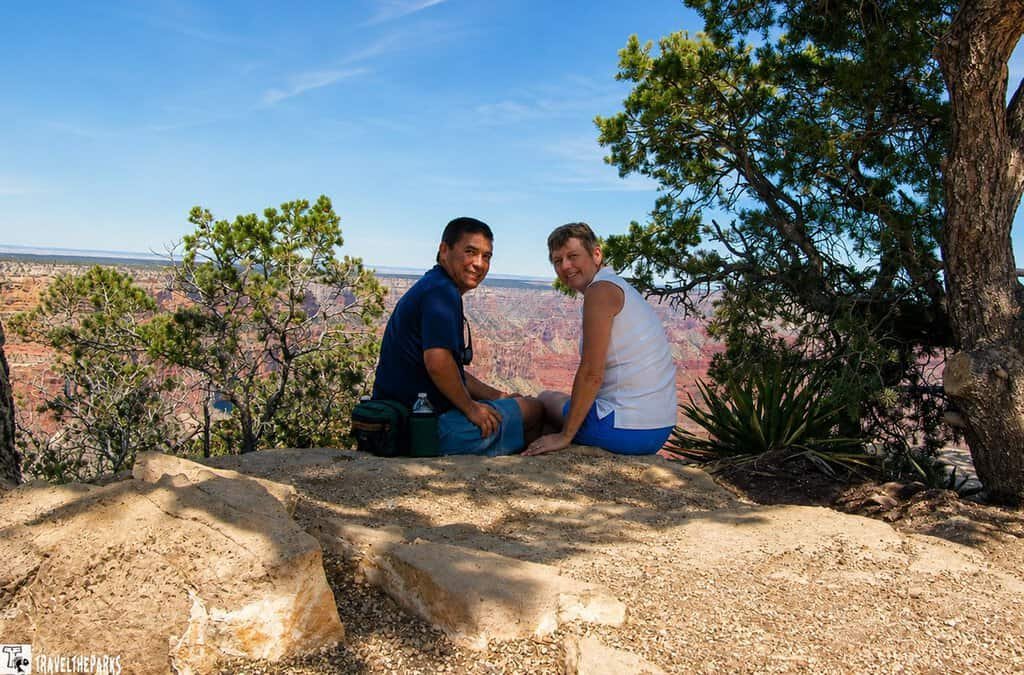
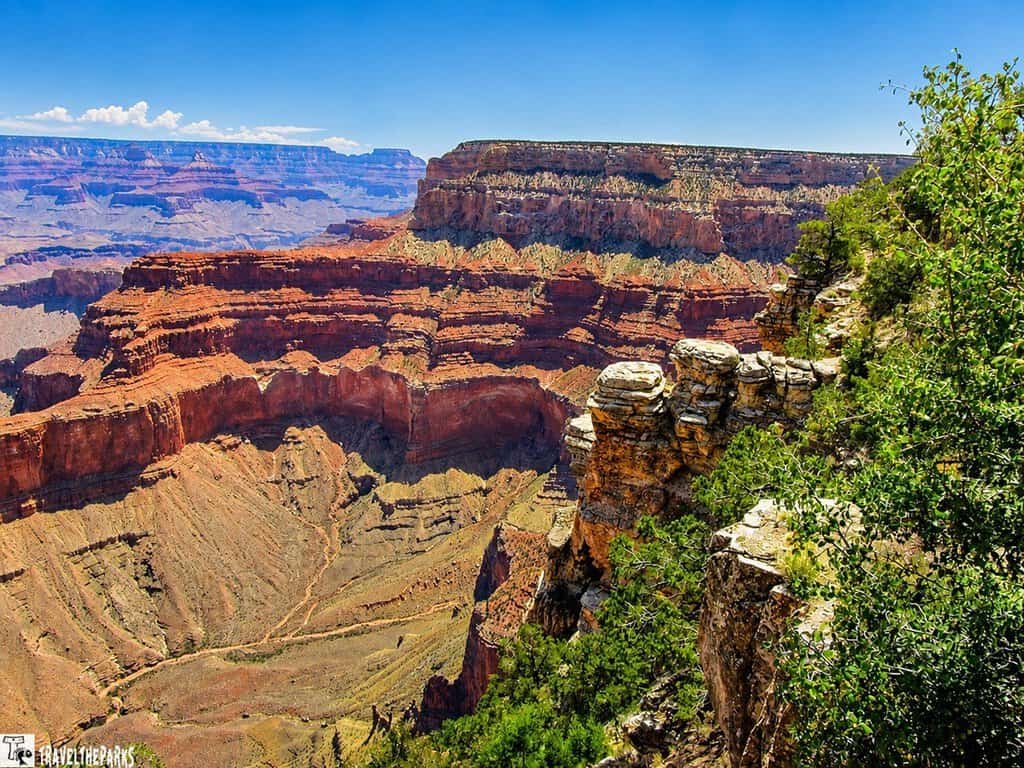
Pima Point was one of our favorite viewpoints along Hermit Road. On a quiet day, you can sometimes hear the Colorado River far below as it moves through the canyon.
The views are enormous, stretching toward the river, Powell Plateau, and Bright Angel Canyon. Looking west, you can also see toward Hermit Creek and the area around the former Hermit Camp.
We sat for a while taking in the scenery and watching the wildlife. At one point, we saw someone giving water to a squirrel. I wasn’t sure that was such a good idea—the squirrels are wild animals, and feeding or watering them can encourage them to approach people.
End of the Road: Hermits Rest
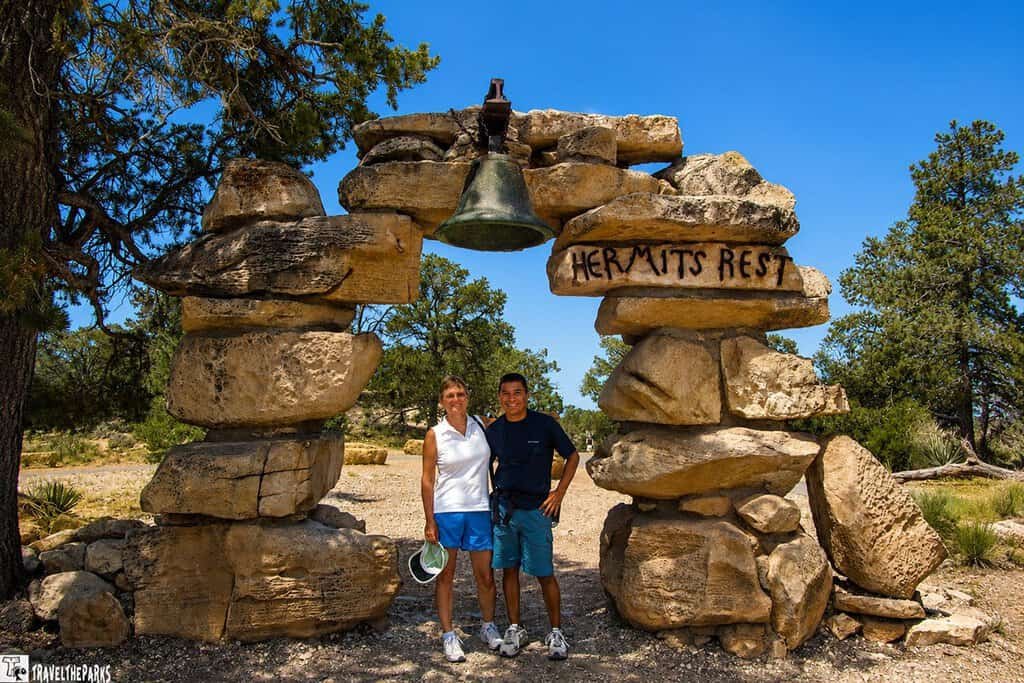
Hermits Rest is the western end of the developed portion of the South Rim and was the final stop on our Hermit Road adventure.
The first thing we noticed was the unusual stone-and-timber building tucked into the landscape. It looks almost as though it belongs naturally in the canyon, but Hermits Rest was actually designed and built in 1914 for the Fred Harvey Company.
We went inside to see the enormous fireplace and browse the small shop. And after spending the afternoon in the blistering heat, the ice cream was especially welcome!
The shop also offered snacks and drinks, along with the usual assortment of souvenirs. There was a water station where we could refill our bottles before heading back.
Hermits Rest was a fitting end to our afternoon. After seeing so many different perspectives of the canyon along the way, it was hard to pick a favorite.
Have Dinner at the El Tovar Lodge Dining Room
After spending so much time exploring Grand Canyon National Park South Rim, we decided to go all out on our last evening and make reservations at the El Tovar Lodge Dining Room.
We had looked over the menu before our stay, so we already knew what we wanted when we arrived. I ordered the sautéed duck breast with blueberry compote, roasted red potatoes, and carrots. It was perfectly cooked and beautifully presented. Barry chose the veal jägerschnitzel and especially enjoyed the German potatoes.
We shared crème brûlée for dessert, which was the perfect way to finish the meal.
The service was quick and professional, but the setting was what really made the evening special. We had wonderful views of the canyon through the dining room windows, and the historic lodge had an atmosphere that made the whole experience feel like an occasion.
Yes, it was an expensive dinner, but for us, the memory was worth every penny. After all, we didn’t come to the Grand Canyon every day!
We would happily eat here again and would recommend making the El Tovar Dining Room part of your visit if you’re looking to splurge on a memorable meal.
Explore Historic El Tovar Hotel
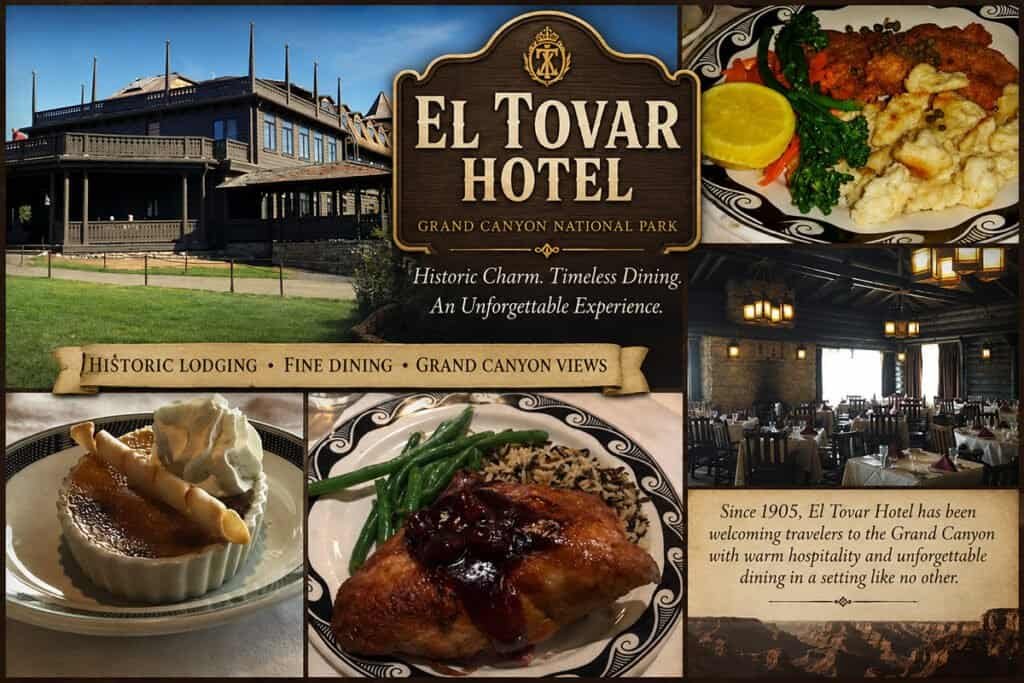
After dinner, we took some time to walk around the historic El Tovar Hotel. Sitting right along the South Rim, the lodge has been welcoming visitors since 1905. Its combination of massive timber, stone, and rustic details gives it a character that feels perfectly suited to the Grand Canyon.
The hotel has hosted its share of famous guests over the years, including Theodore Roosevelt, Albert Einstein, and Western writer Zane Grey. But for us, the history wasn’t just something we read about—it was something we could feel as we wandered through the common areas after dinner.
Inside, the lodge has a warm, welcoming atmosphere that makes you want to slow down and look around. Outside, the back porch is an especially inviting place to sit. Rocking chairs face the canyon, and they fill quickly around sunset as guests settle in with a drink from the bar and watch the changing light.
We didn’t stay at El Tovar, but spending some time here after dinner gave us a chance to experience another side of the South Rim. After a full day of exploring, sitting on the porch and looking out over the canyon would have been a pretty perfect way to end the evening.
Renowned Mather Point for Sunrise
Mather Point is one of the most iconic viewpoints on the South Rim and is conveniently located near the Grand Canyon Visitor Center. The views are spectacular, but there is a trade-off: this is also one of the busiest places along the rim.
Most visitors entering the park for the first time make their way here, and tour buses add to the crowds. During our visit, there were plenty of people trying to get that perfect selfie, so don’t expect a quiet Grand Canyon experience at Mather Point.
That doesn’t mean you should skip it. The views are expansive, and there are paved paths extending in both directions along the rim. Walk a little farther from the main overlook and the crowds begin to thin out. There are also places to sit and simply enjoy the canyon.
Mather Point is especially beautiful around sunrise and sunset. As the light changes, the shadows move across the canyon walls and bring out layers of color that aren’t as noticeable in the middle of the day.
If it’s your first visit to the South Rim, Mather Point is worth seeing. Just arrive early if you want a better chance at finding a parking spot and a little breathing room at the overlook.
Learn About the Grand Canyon at Yavapai Point
Yavapai Observation Station was built in 1928 and is one of the best places along the South Rim to learn about the geology of the Grand Canyon. The views into the inner canyon are excellent, and you can also look back toward Mather Point.
Inside, a large topographic relief model helps put the canyon’s enormous size and complicated geology into perspective. Seeing the layers and formations represented in the model made it much easier to understand how the landscape we were looking at came together.
As a teacher, I couldn’t resist turning the visit into a little classroom inspiration. I put together a video about weathering and erosion in the Grand Canyon to use with my students. It’s one of those places where you can actually see the concepts from a science lesson spread out in front of you.
Grand Canyon National Park was established in 1919 by President Woodrow Wilson. The canyon itself stretches for roughly 277 miles, reaches widths of up to 18 miles in places, and drops more than a mile from the rim to the river. Those numbers are impressive, but standing at the rim and looking across the canyon makes the scale much easier to appreciate.
The Grand Canyon attracts millions of visitors each year, so don’t expect to have this remarkable place entirely to yourself. Still, there are plenty of opportunities to step away from the busiest overlooks and simply take in the scenery.
Follow the Trail of Time
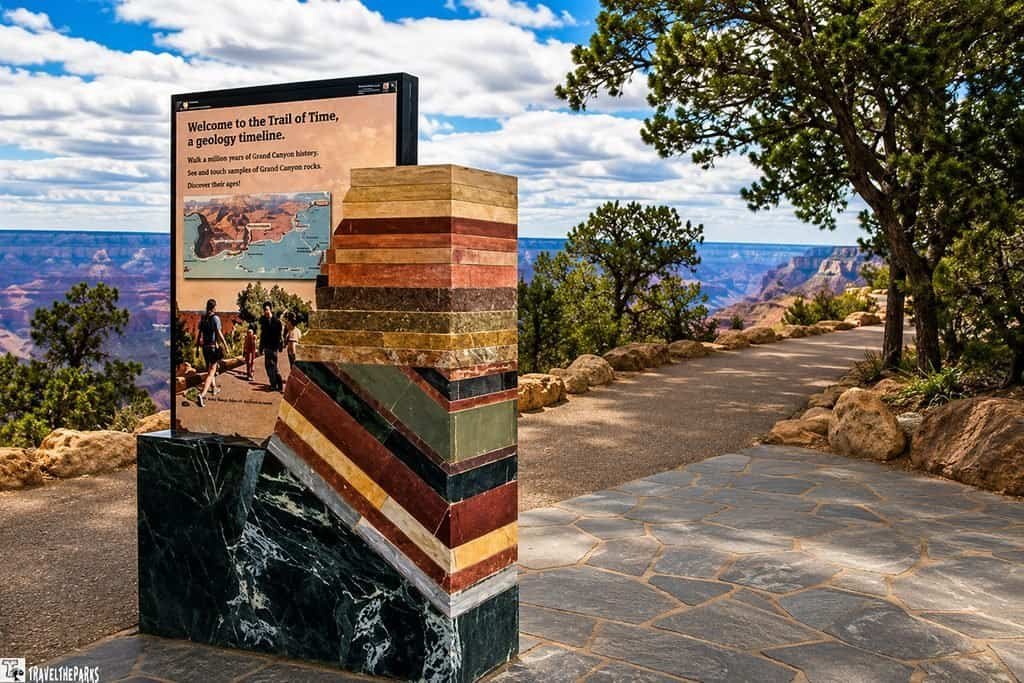
If you want to understand how the Grand Canyon came to look the way it does today, take some time to follow the Trail of Time near Yavapai Point. The trail uses the canyon itself as a giant geology lesson, with displays along the way explaining the age and formation of the rocks beneath your feet.
Weathering and erosion have shaped the canyon over an incredibly long period of time, cutting through layer after layer of sedimentary rock before reaching the much older rocks deep within the canyon. Among those ancient rocks are Vishnu Schist and Zoroaster Granite.
What I enjoyed about the Trail of Time was that it made the geology easier to understand. Instead of simply looking at colorful rock layers from the rim, you can connect what you’re seeing to the tremendous amount of time involved in creating this landscape.
The Trail of Time is especially worthwhile if you’re visiting with kids. It turns a walk along the South Rim into an opportunity to learn about geology, erosion, and the forces that continue to shape the Grand Canyon.
Final Thoughts: Grand Canyon National Park South Rim
The South Rim is the most visited side of the Grand Canyon, and after spending time here, I understand why. There are countless viewpoints, historic buildings, trails, wildlife, and opportunities to see the canyon from completely different perspectives.
But I still have a soft spot for the North Rim Grand Canyon. I found it just as beautiful as the South Rim, but with a much greater sense of solitude. Barry preferred the South Rim, while I enjoyed the quieter atmosphere on the North Rim. That’s one of the things I love about the Grand Canyon—both rims offer something different.
I’d love to return during the winter someday to see how dramatically the landscape changes with the seasons.
If you have more than a few days, consider going below the rim rather than experiencing the canyon entirely from above. The Bright Angel and South Kaibab trails offer opportunities to see the canyon from a completely different perspective, although any hike below the rim requires careful planning and plenty of time for the return climb.
After finally checking the Grand Canyon off our bucket list, I can say it lived up to the anticipation. If you haven’t been, put it on your list. And if you’ve already visited, you probably know exactly why we want to go back.
Have you visited the Grand Canyon South Rim? What was your favorite memory? We’d love to hear about it. Share your experience with us in the comments!